Patents and Section 101 — Defenses Based on the Basics
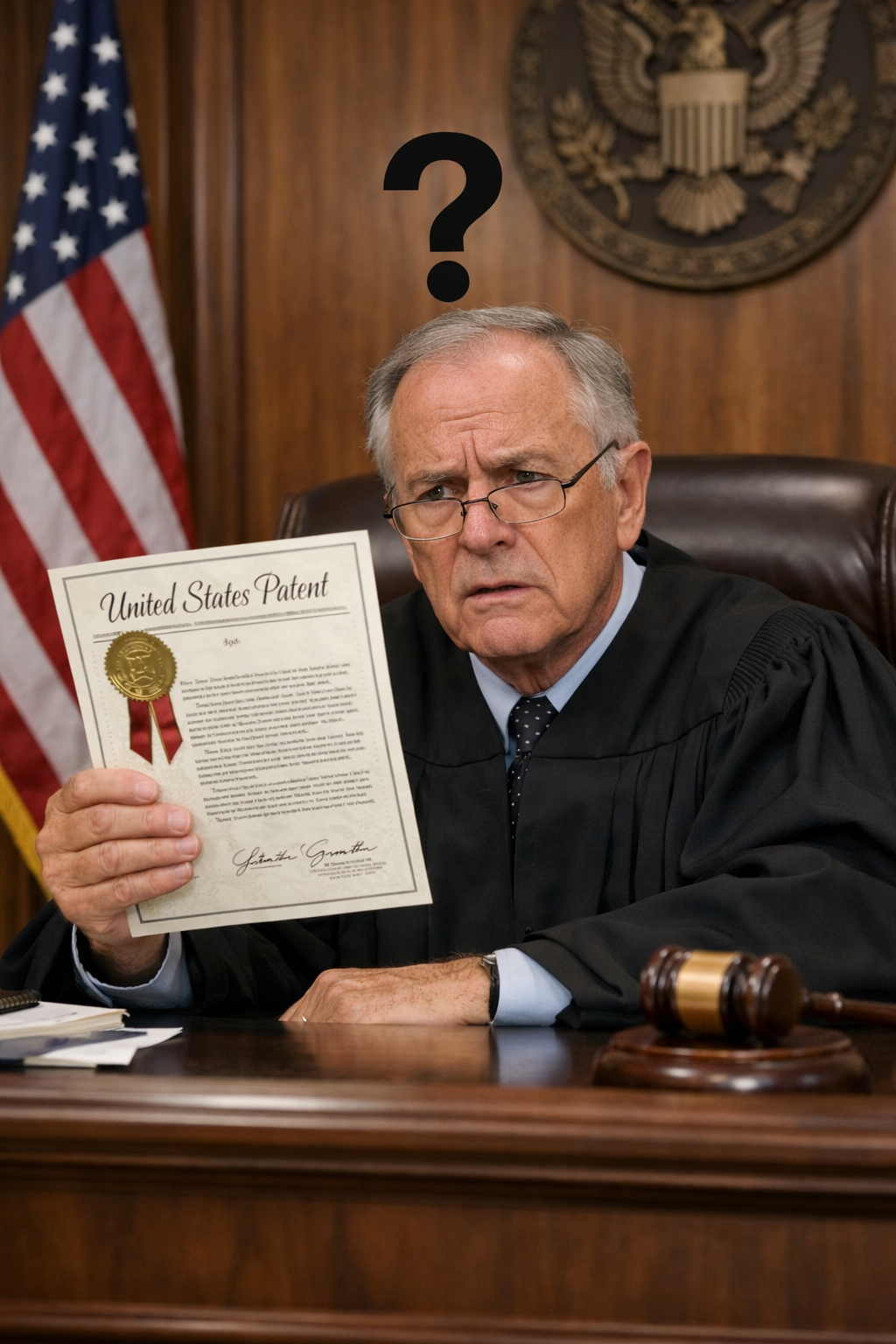
For today’s article, we are going to take a look at patent law. We’ll begin with the most basic part of that law, which has become surprisingly complicated in recent years.
Imagine this:
You are an inventor with a good idea. You build an AI‑driven system that predicts the safest and most efficient way to get from Point A to Point B on your bicycle. It accounts for traffic patterns, accident data, weather, road quality, and time of day. You turn it into a popular app. Cyclists love it. Time is saved. Injuries are avoided.
This is worth protecting. So, you hire experienced patent counsel. You disclose the invention fully. You respond to office actions. You work with your counsel to write and rewrite clear patent claims. After years of effort—and a small fortune—you receive a United States patent. The Patent Office has examined your claims and agreed: this is an invention! You receive a United States Patent, complete with a big ribbon and gold seal (since you ordered a presentation copy instead of just the actual official digital version.)
Then a competitor comes along. They release an app that you are convinced is a close copy of your app. Your user base erodes. You sue.
A few months later, your lawyer calls. The case has been dismissed. There will be no discovery, no expert reports, and no trial. The only thing left is an appeal, and that doesn’t look good based on recent cases.
What the heck happened? The U.S. Patent Office, whose job is to determine what inventions are worthy of a patent, has decided yours was. How can this be?
Meet Section 101 of the patent statute.
Why Section 101 Now Matters More Than Ever
Section 101 has always been foundational. But in the current technical climate—particularly for software, AI, and data‑driven inventions—it has become even more important.
Courts increasingly resolve patent cases at the pleadings stage based on §101. Defendants almost routinely raise eligibility challenges before claim construction or discovery. And many succeed. The result is front‑loaded adjudication that can end a case before it meaningfully begins.
In the grand morality play that is often involved in patent cases, this seems likes an unfair trap for innovators. For defendants, who often view inventors suing them as “patent trolls,” this seems more like a godsend.
Let’s have a closer look.
The Statutory Gate Keeper
Section 101 permits patents for any new and useful process, machine, manufacture, or composition of matter, or any improvement thereof.¹. That sounds simple enough. But it isn’t.
Courts have long recognized implicit exceptions for laws of nature, natural phenomena, and abstract ideas. Because those are basic building blocks of human knowledge, which must remain free for everyone to use rather than being monopolized through exclusive patent rights. Eligibility is therefore a threshold inquiry. That inquiry determines whether a claimed invention can even be considered for a patent.
The Supreme Court Framework
Modern eligibility doctrine originated in Mayo Collaborative Services v. Prometheus Laboratories and Alice Corp. v. CLS Bank International. ² Together, those cases established a two‑step framework that controls §101 litigation: Step one, determine whether the claims are directed to a law of nature, natural phenomenon, or abstract idea. Step two, if so, determine whether the claim elements, individually or as an ordered combination, add an “inventive concept” sufficient to transform the abstract idea into a patent-eligible application.
In Mayo, the Court found that upholding the patents would risk disproportionately tying up the use of the underlying natural laws, inhibiting their use in the making of further discoveries.
In Alice, involving computer technology, the Court found “[t]he mere recitation of a generic computer cannot transform a patent‑ineligible abstract idea into a patent‑eligible invention.” ³
How Cases Get Dismissed Early
Following Alice, the Federal Circuit repeatedly affirmed dismissals under Rule 12(b)(6), often without claim construction or factual development. For example, in buySAFE, Inc. v. Google, Inc., claims directed to guaranteeing online transactions were dismissed because generic computer implementation added nothing inventive.⁴ The court put it this way: “That a computer receives and sends the information over a network—with no further specification—is not even arguably inventive.”
In Content Extraction & Transmission LLC v. Wells Fargo Bank, claims covering data extraction and storage were held abstract as a matter of law.⁵ And Electric Power Group, LLC v. Alstom S.A. reinforced the point; limiting claims to a technical field does not rescue claims focused on gathering and analyzing information. ⁶ The Court summarized it succinctly: “The claims, defining a desirable information-based result and not limited to inventive means of achieving the result, fail under § 101.”
When Software Claims Survive
Still, not all software patents fail under §101. In McRO, Inc. v. Bandai Namco Games America Inc., the Federal Circuit reversed a §101 dismissal, holding that claims directed to specific rules for automating animation were not abstract.⁸ The court noted that, “[t]he claimed rules allow automation of a task previously performed by humans, but they do so in a particular way that improves the functioning of the computer itself.” ⁹
Similarly, BASCOM Global Internet Services, Inc. v. AT&T Mobility LLC held that an inventive concept may arise from a non‑conventional arrangement of known components. ¹⁰
Facts Matter
The Federal Circuit has made clear that §101 is not always suitable for resolution on the pleadings. In Berkheimer v. HP Inc., the court held that whether elements are well‑understood, routine, and conventional can be a question of fact. ¹¹ Aatrix Software, Inc. v. Green Shades Software, Inc. reinforced that claim construction disputes and factual allegations may preclude dismissal. ¹²
Judicial Criticism of the Doctrine
Section 101 jurisprudence has drawn unusually direct criticism from within the Federal Circuit itself. Judges have repeatedly expressed concern that the doctrine has become unpredictable. Judge Moore put it this way: “As the nation’s lone patent court, we are at a loss as to how to uniformly apply § 101. The judicially created exceptions to § 101 have swallowed the rule, and we are now regularly denying patent protection to inventions that are unquestionably new, useful, and non-obvious.” 13
Legislative Efforts and Supreme Court Silence
Congress has taken notice. Multiple legislative proposals, including versions of the Patent Eligibility Restoration Act, have sought to narrow the abstract‑idea exception and restore predictability to §101. None has yet been enacted.
Meanwhile, the Supreme Court has repeatedly declined invitations to revisit Alice and Mayo, denying certiorari in case after case presenting eligibility questions. For now, the Court appears content to let the doctrine evolve in the lower courts, even if that evolution is uneven.
Where This Leaves Us
Section 101 is not disappearing. But the response to the recent focus on §101 is evolving. Patent prosecutors are drafting with eligibility in mind. Examiners explain eligibility rejections more explicitly. Courts are increasingly attentive to factual disputes and technological context. Over time, inventors, lawyers, examiners, and judges may converge on a shared understanding of where §101 draws the line. Or there may be legislation to clarify things – but don’t hold your breath on that.
That is all cold comfort, of course, to the inventor of the bike‑routing app whose patent never made it past a motion to dismiss. But the successful defendant who enjoyed an early dismissal undoubtedly thinks things are just fine.
Footnotes
1. 35 U.S.C. § 101.
2. Mayo Collaborative Servs. v. Prometheus Labs., Inc., 566 U.S. 66 (2012); Alice Corp. Pty. Ltd. v. CLS Bank Int’l, 573 U.S. 208 (2014).
3. Alice, 573 U.S. at 223.
4. buySAFE, Inc. v. Google, Inc., 765 F.3d 1350 (Fed. Cir. 2014).
5. Content Extraction & Transmission LLC v. Wells Fargo Bank, N.A., 776 F.3d 1343 (Fed. Cir. 2014).
6. Electric Power Group, LLC v. Alstom S.A., 830 F.3d 1350 (Fed. Cir. 2016).
7. buySAFE, 765 F.3d at 1355.
8. McRO, Inc. v. Bandai Namco Games Am. Inc., 837 F.3d 1299 (Fed. Cir. 2016).
9. Id. at 1315.
10. BASCOM Glob. Internet Servs., Inc. v. AT&T Mobility LLC, 827 F.3d 1341 (Fed. Cir. 2016).
11. Berkheimer v. HP Inc., 881 F.3d 1360 (Fed. Cir. 2018).
12. Aatrix Software, Inc. v. Green Shades Software, Inc., 882 F.3d 1121 (Fed. Cir. 2018).
13. American Axle & Mfg., Inc. v. Neapco Holdings LLC, No. 18-1763, concurring opinion of Moore, J., in the order denying stay of mandate, at 7–8 (Fed. Cir. Oct. 23, 2020).