Consider this: Under five percent of civil disputes are actually tried. That means your IP dispute will likely be settled in some way short of trial. The most likely way — short of settlement directly between the parties — is mediation. The second most likely is by judicial settlement conference, which typically will happen on the eve of trial after the parties have sunk thousands or even millions into trial preparation. That means you will want to treat the mediation as every bit as important as the trial. This checklist is designed to help you do that.
IP mediations are still commercial mediations, so the same basic issues are involved. What are the risks? What will it cost to keep fighting? Who needs to be in the room? What business result is actually worth pursuing? But IP disputes usually add a few complications of their own: technical proof, uncertain valuation, possible injunctions, parallel proceedings, strong emotions, and settlement structures that can become more complicated than anyone expected. With that in mind, here is a practical checklist for preparing for your next IP mediation.
You will want to consult this list (or a better one if you have it) well before the mediation. Determining when to mediate, who to mediate, and other items on the checklist can’t be done in the week before the mediation session.
1. Identify what kind of IP dispute you actually have.
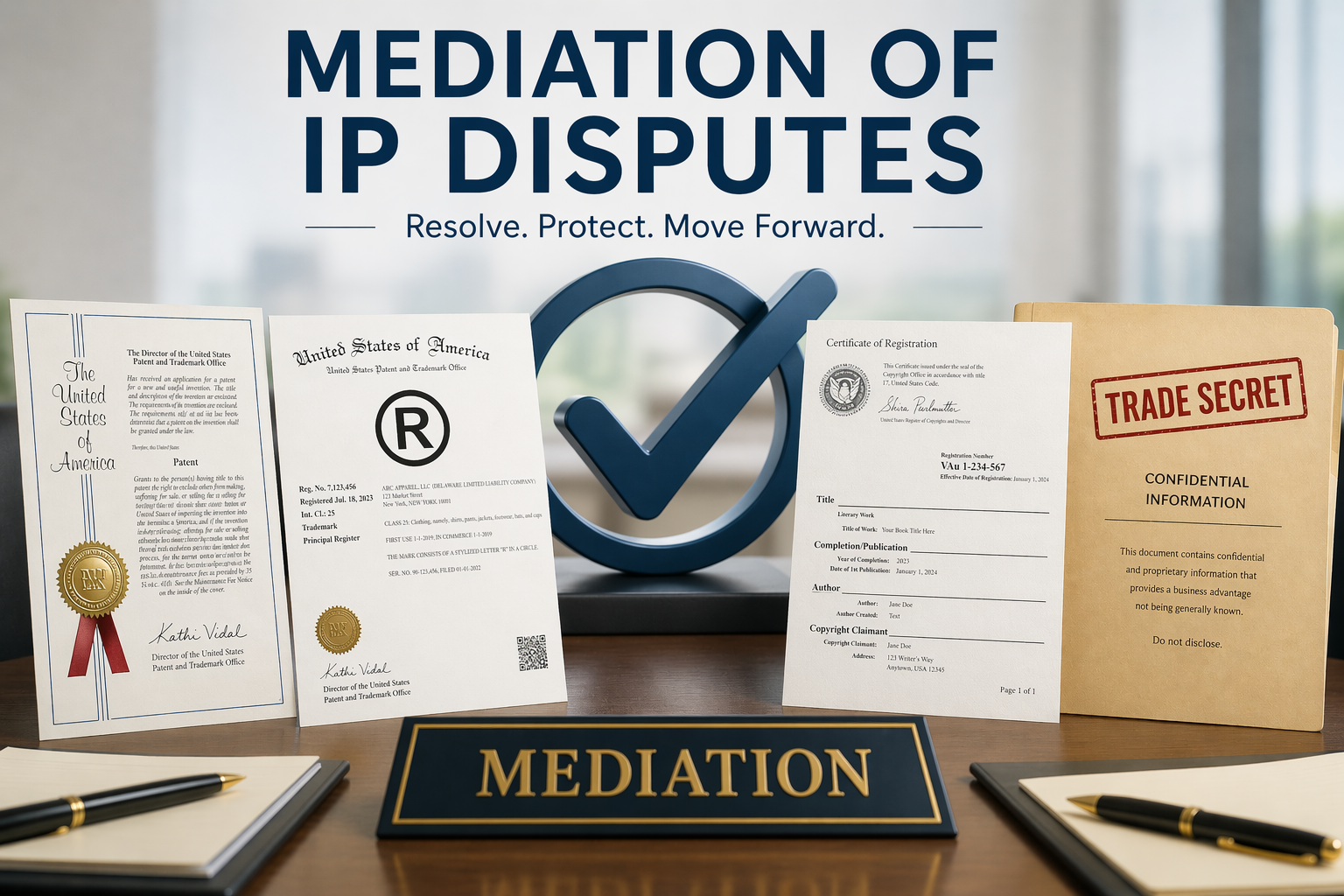
Key aspects of IP disputes vary. Patent cases often turn on claim construction, infringement analysis, validity defenses, and expensive damages work. Trade secret cases usually bring fights over whether the information was truly secret, whether reasonable steps were taken to protect it, and whether the defendant actually used it. Copyright disputes may involve anything from software to music to film and often raise difficult questions about copying, derivative works, fair use, and ownership. Trademark cases usually revolve around likely confusion, surveys, brand value, and requests for injunctive relief. Some cases involve several of these at once.
Checklist:
□ Identify each IP claim in play.
□ Identify the key legal elements for each claim and defense.
□ Identify any request for injunctive relief.
□ Identify whether multiple forms of IP are involved in the same dispute. Are some more important than others?
2. The technical case.
IP mediations often stall because one or both sides talk in conclusions instead of specifics. In patent cases, the specifics are the claims, the accused product, the prior art, and any important claim-construction issues. In trade secret cases, it means identifying the alleged secrets with precision and understanding the claimed misuse and efforts to keep them secret. In copyright and trademark cases, it means understanding exactly what was copied or used, how to prove it, and why that matters under the governing law.
Checklist:
□ Identify the core technical or factual issue that will likely drive outcome.
□ Determine what the other side says is being used, copied, or misappropriated, why they say that has not taken place, or other relevant matters.
□ Determine what is actually disputed and what is not.
3. Realistically evaluate damages
Quantifying IP damages is complicated. Patent cases can involve reasonable royalties, lost profits on lost sales, or other measures. The rules around computing such damages are complicated. Experts now encounter skepticism from courts. Trademark and trade secrets cases involve similar measures, but the rules are somewhat different. Copyright cases require an election between statutory and actual damages. All cases can involve enhanced damages for willful conduct. Attorneys’ fees may be sought, though they are difficult to actually obtain. And injunctions can have real consequences. You will need to have a damages approach that you can justify and explain based on the evidence. You may want to set up an Excel spreadsheet which allows you to input different assumptions and elements, so you can quickly analyze various possibilities and assumptions.
□ Determine the measure of damages for the IP involved in your case
□ What can you prove? Think about upper and lower ranges. There are enough complications that this is more than just a math problem.
□ Consider creating an Excel spreadsheet so you can input various rates, products, timing, and other assumptions to let you evaluate variables in real time.
4. Understand the procedural posture.
Timing is critical in IP cases. A Markman ruling in a patent case can reshape the whole negotiation. A preliminary injunction ruling in a trademark or trade secret case can do the same. A pending Patent Office proceeding may affect leverage, valuation, and settlement structure. Mediation is more productive when the parties have enough information to make a reasoned decision, but before they have spent themselves into a position where they have spent so much they feel they need to see things through to the end.
Checklist:
□ Identify any upcoming or recent ruling that materially affects settlement value.
□ Identify any parallel administrative proceeding.
□ Determine what discovery has been completed and what is still missing.
□ Ask whether the parties know enough now to negotiate intelligently.
5. Do a real risk analysis, not a mediation-day performance.
Before the mediation, each side should know its best and worst likely outcomes if the case does not settle. That includes trial risk, appellate risk, injunction risk, business disruption, legal spending, and management distraction. Remember that, in IP disputes, damages theories and defenses often seem better on paper than they do in front of a jury. Reasonable royalty, lost profits, disgorgement, statutory damages, enhanced damages, and ongoing royalties all need sober analysis and a common-sense explanation.
Checklist:
□ Evaluate best likely outcome if the case is tried.
□ Evaluate worst likely outcome if the case is tried.
□ Estimate fees, court costs and expert costs through trial and appeal.
□ Identify where the damages model is strong and where it is vulnerable.
□ Assess the practical consequences of an injunction.
6. Figure out the business problem behind the lawsuit. This is often the key to a settlement.
Most IP plaintiffs are not suing for the sheer joy of defending IP rights. They are usually trying to stop competition, protect market share, preserve leverage, defend a licensing model, protect a relationship, or send a message. The defendant usually has its own business logic as well. Until those interests are identified, the mediation will tend to drift back into a debate over who is right.
Checklist:
□ Identify the business purpose behind the claim or defense.
□ Determine what harm each party actually wants stopped.
□ Determine what business result would count as a win short of trial.
□ Consider whether the dispute could be resolved with a business arrangement rather than a damages payment alone.
7. Do not underestimate emotions.
IP cases are often more personal than you might suppose. Inventors identify with their inventions. Trade secret cases can feel like betrayal cases. Trademark disputes often touch brand identity and pride. Former employees, former business partners, and long-time competitors can bring a lot of history into the room. You normally can’t just ignore it.
Checklist:
□ Identify the emotional drivers in the case.
□ Determine whether any representative is too angry or too invested to negotiate effectively.
□ Consider whether party history needs to be addressed before numbers are discussed.
□ Choose attendees who can stay objective under pressure.
□ It may be necessary to rebuild trust during the mediation where that has broken down. Be sure your clients understand that and act accordingly.
8. Pick the right mediator.
In IP cases, mediator selection can be critical. The mediator does not need to be the smartest engineer in the room but does need enough technical and legal fluency to understand the dispute and test positions credibly. And the mediator needs enough business sense and practical judgment to help the parties structure a resolution that works in the real world. He or she must also know how to mediate. Bringing parties to a settlement is a whole different skill than analyzing legal claims.
Checklist:
□ Evaluate the mediator’s IP experience.
□ Evaluate whether the mediator can handle the technical subject matter.
□ Evaluate whether the mediator understands licensing, business solutions, and settlement architecture.
□ Determine the mediator’s mediation skills and experience.
9. Decide who must attend the mediation and make sure they have authority to settle.
Courts and mediators require someone with settlement authority. In IP cases, that may not be enough. You may also need a technical person, a business decision-maker, licensing personnel, or someone who can speak to operational feasibility. A settlement may fail simply because nobody present can answer whether a product can be redesigned, a mark can be changed, or a royalty structure can work in the real world. And some people are very successful at business but not so great at negotiating and approaching a situation from a settlement prospective. You need the right people for all these things.
Checklist:
□ Send a representative with actual authority.
□ Make sure the participants match the complexity of the settlement issues.
□ Include technical or product personnel if needed.
□ Include someone who understands the commercial consequences of proposed terms.
□ Make sure you have a good, practical negotiator on the team
10. Decide what information must be exchanged before the session.
Many mediations fail because the parties still do not trust the numbers or the other side’s representation of the facts. Usually, the answer is not full-blown discovery. Instead, a targeted exchange of a limited number of key documents is enough. Sales data, royalty information, technical exemplars, survey material, or a more precise description of the claimed trade secrets may be enough to allow the parties to negotiate sensibly.
Checklist:
□ Identify the minimum information needed for informed negotiation.
□ Exchange targeted information before the mediation.
□ Confirm whether damages can be reasonably estimated.
□ Confirm whether technical feasibility issues can be evaluated.
11. Think through the settlement structure before the mediation starts.
In IP disputes, settlement is usually about more than writing a check. The parties may need a license, a cross-license, a phase-out period, a redesign, restrictions on use, a coexistence agreement, quality-control provisions, dismissal of foreign proceedings, or resolution of Patent Office challenges. If nobody has thought through structure in advance, a settlement can run aground when the discussion moves past abstract agreement. If your think a license is necessary, have a draft so you can discuss the key terms. Find a way to identify the products, designs, patent or trademark numbers, and the like succinctly and clearly so the settlement is clear.
Checklist:
□ Decide whether a payment-only settlement is realistic.
□ Consider licensing, cross-licensing, redesign, coexistence, or supply arrangements.
□ Identify whether global peace is needed across cases, products, jurisdictions, or patents.
□ Consider how future disputes will be avoided. Parties often incorporate arbitration provisions for a quick determination of discrete disputes that may arise.
12. Plan the mediation session itself.
Opening statements can help in IP cases because they allow explanation of difficult technical issues. They can also make things worse if counsel treat the session like closing argument. Consider written exchanges before the session. That gives the parties a chance to analyze the other’s position rather than react immediately — and often emotionally. The session should be planned, not improvised.
Checklist:
□ Decide whether opening statements will help or inflame and discuss that with the mediator as appropriate.
□ Exchange meaningful pre-mediation submissions.
□ Give the mediator the key technical and legal materials. But don’t overwhelm with details. Focus on the key patent claims, products, marks, writings, copyright registrations, etc.
□ Provide confidential information for the mediator about settlement obstacles, business interests, and personalities through a pre-mediation phone call or a separate confidential letter. But make sure the mediator understands exactly what he or the must keep confidential.
13. Use caucus productively.
Once the mediation begins, the job is not a miniature trial of the case. It is to analyze risk, identify the real impediments to settlement, and move the discussion from legal positions to practical resolution. That may require separate meetings with businesspeople, separate lawyer-to-lawyer sessions, or a pause to obtain missing information.
Checklist:
□ Use caucus to test assumptions, not just repeat arguments.
□ Make sure the client hears the weaknesses in its own case. Very few cases are airtight.
□ Explore more than one settlement structure if necessary.
□ Reconfigure meeting groups if that will help break impasse.
□ Adjourn and exchange targeted information if the parties still cannot assess value intelligently.
14. Impasse happens.
Impasse at the first session does not necessarily mean the mediation failed. Some disputes are too complicated to settle in one pass. A useful first session may narrow issues, identify structure, surface missing information, and lay the groundwork for a second session or follow-up negotiations.
Checklist:
□ Don’t treat first-session impasse as fatal.
□ Identify what progress was actually made.
□ Decide what information or movement is needed before the next step.
□ Preserve mediator involvement after the session if appropriate.
15. Prepare to document the settlement; no writing really means no real settlement yet.
IP settlements can go off track. The more complicated the dispute, the more dangerous it is to rely on shorthand like “usual license terms” or “stop infringing.” Those phrases are invitations to later disagreement. The key deal points need to be identified specifically, and as much of the structure as possible should be documented before the parties leave. And remember some settlements between competitors can implicate anti-trust concerns. Think about that ahead of time.
Checklist:
□ Precisely identify the IP covered by the settlement.
□ Identify the products, works, marks, processes, information, or territories covered.
□ Specify whether the settlement includes a license, release, redesign, coexistence arrangement, or payment terms.
□ Address royalty base, rate, timing, audit rights, and duration where applicable.
□ Address quality control in trademark licenses.
□ Consider whether antitrust or other regulatory issues could arise.
□ Prepare a term sheet or outline with as many specifics as possible before the mediation ends.
16. Make sure the settlement really ends the fight.
A settlement that leaves room for the next lawsuit is usually not much of a settlement. Defendants often worry about related patents, related applications, foreign rights, or other information or IP not expressly covered by the deal. Plaintiffs worry about compliance, future misuse, and whether they have given away too much. Those concerns need to be addressed directly.
Checklist:
□ Determine whether related IP must be included for real peace.
□ Address pending foreign or administrative proceedings if they matter.
□ Include compliance mechanisms where appropriate.
□ Confirm that the deal ends the hostilities the parties actually care about ending.
Conclusion
An IP mediation is still a commercial mediation. You must know the facts, assess the risks, bring the right people, and focus on the business problem instead of just the legal issues.
But IP disputes usually add technical complexity, injunction pressure, emotional history, and settlement structures that take more thought than a simple payment term. A well-prepared party arrives at the mediation not just ready to argue the merits, but ready to solve the problem. That can’t be done without focused, careful planning.