When “No Appeal” Doesn’t Mean No Appeal: Lanesborough, the FAA, and What You Can (and Cannot) Waive
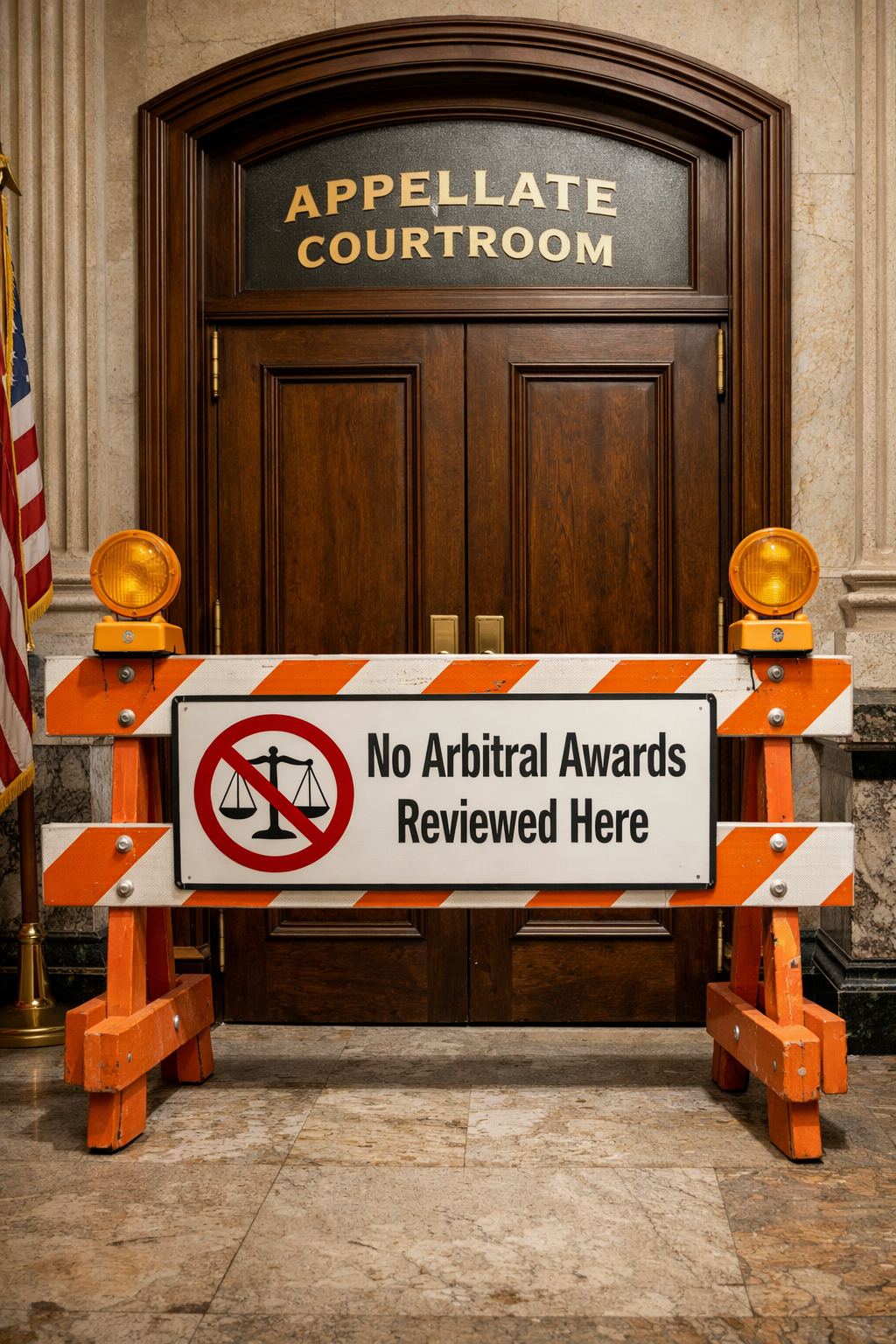
The Federal Arbitration Act was enacted in 1925. As I keep harping on, the point of the Act is to make arbitration contracts enforceable. But they require judicial enforcement. Arbitrators don’t have marshals, sheriffs, jails and writs of attachments to enforce awards. To enforce an arbitrator’s decision -- an “Award” in arbitration-speak -- you need a court.
And if you want a court to enforce an award, you need to get past the FAA’s grounds for vacating an arbitration award. They are limited to things like corruption or fraud, evident partiality, arbitrator misconduct that prejudices a party, or where the arbitrators exceeded their powers.
The Second Circuit’s decision in Lanesborough 2000, LLC v. Nextres, LLC [i] holds that a generic waiver of “the right to appeal” is not sufficiently clear to bar appellate review of a district court’s confirmation order. This implies that a properly done waiver of a right to appeal could work. Can it?
Let’s Start with Lanesborough
In Lanesborough, the parties’ arbitration agreement included a waiver of “THE RIGHT TO APPEAL.” After the district court largely confirmed the award, the losing party appealed. The prevailing party argued that the appeal should be dismissed because the right to appeal had been waived.
The Second Circuit disagreed. But that was not because appellate waivers are impossible. Rather, this waiver was too vague. The court held that a waiver of appellate review must be “clear and unequivocal.” The clause did not specify whether it referred to appeal of the arbitral award itself, appeal of the district court’s confirmation order, or something else. Ambiguity meant appellate jurisdiction remained.
Importantly, the panel did not say appellate waivers are unenforceable. It simply refused to enforce this one and expressly left open whether a properly drafted waiver would work.
Wait a minute – what about the FAA?
How does that square with the cases that say you cannot waive judicial review under the FAA? Isn’t there a line of authority holding that some review is mandatory?
Yes. But it depends on what kind of review we are talking about.
The FAA’s Minimum Review Principle
Let’s go to Hoeft v. MVL Group, Inc. (2d Cir. 2003) [ii]. Hoeft recognized that arbitration may be private, but confirmation and vacatur invoke federal judicial power. When parties seek a federal judgment under 9 U.S.C. §§ 9–11, the district court performs a limited statutory function. That statutory role cannot simply be written out of the contract.
The Ninth Circuit said much the same in In re Wal‑Mart Wage & Hour Employment Practices Litigation (9th Cir. 2013) [iii], concluding that a clause eliminating all federal court review, including review under § 10, could not be enforced.
Those decisions establish a floor. If you want a federal judgment, you get the FAA’s limited judicial oversight along with it.
Appellate Review Is a Different Question
This brings us to appellate review. Courts have found eliminating the district court’s statutory review role is one thing. Eliminating appellate review of what the district court has already done is another. Several circuits have treated those as distinct.
In Beckley Oncology Associates, Inc. v. Abumasmah [iv], the Fourth Circuit enforced an appellate waiver and dismissed the appeal, recognizing that the district court had already performed its FAA function. The court reasoned that “the appellant “received a ‘minimum level of due process’ before the district court. Thus, even if the parties couldn’t waive all judicial review of the arbitration award, they were certainly free to waive appellate review of the district court’s decision confirming or vacating the award.”
The Tenth Circuit reached a similar result in MACTEC, Inc. v. Gorelick (10th Cir. 2005) [v], enforcing language making the judgment “final and nonappealable.”
Those cases do not eliminate district court review. They eliminate a second layer of review. That’s why they don’t fun afoul of the requirement of judicial review found in Hoeft and Wal‑Mart.
So Where Does This All Leave Us?
Lanesborough teaches us that, if you intend to waive appellate review of a district court’s order confirming, vacating, or modifying an award, say so expressly. “Waive the right to appeal” may sound strong. But it is not specific enough to foreclose jurisdiction, at least in the Second Circuit.
At the same time, courts find the FAA will not allow parties to transform confirmation into a rubber stamp. Section 10 review remains part of the enforcement framework where a federal judgment is sought.
And before you decide to start writing appellate review out of your arbitration, you will want to have a look at the guidance, if any, in your circuit if you decide foregoing appellate review makes sense. It may. One Fourth Circuit case lamented that the “almost reflexive appeal of arbitration awards seems to be an increasingly common course, leading to arbitration no longer being treated as an alternative to litigation, but as its precursor.” [vi]
So, if you want to draft a waiver of appellate review, so far the rule is this: Be clear and you can stop your arbitration journey at the district court.
Footnotes
[i] Lanesborough 2000, LLC v. Nextres, LLC. Nos. 24-2211(L), 25-662 (Con) (2d Cir. Feb. 6, 2026)
[ii] Hoeft v. MVL Group, Inc., 343 F.3d 57 (2d Cir. 2003).
[iii] In re Wal‑Mart Wage & Hour Employment Practices Litigation, 737 F.3d 1262 (9th Cir. 2013)
[iv] Beckley Oncology Associates, Inc. v. Abumasmah, 933 F.3d 261 (4th Cir. 2021)
[v] MACTEC, Inc. v. Gorelick, 427 F.3d 821 (10th Cir. 2005).
[vi] Tecnocap, LLC v. United Steel, Paper & Forestry, Rubber, Mfg., Energy, Allied Indus. & v Serv. Workers Int'l Union AFL-CIO/CLC, Loc. Union No. 152M, No. 19-1263, 2021 WL 164677, at *4 (4th Cir. Jan. 19, 2021) (unpublished) (per curiam).