Arbitration in 1776: Older Than the Republic
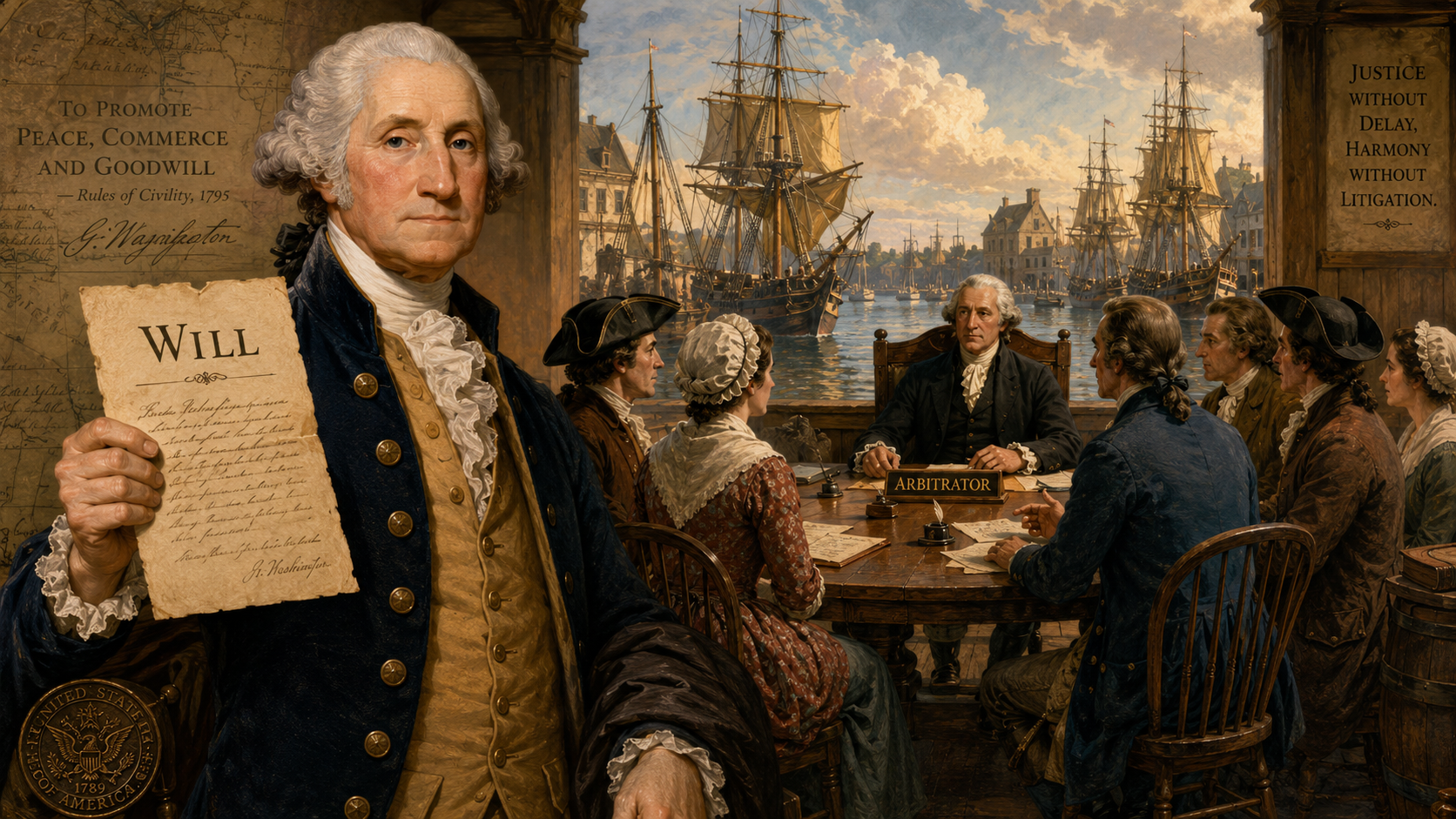
As the United States approaches its 250th birthday, arbitration has an anniversary of its own. By 1776, Americans already knew the basic bargain: choose respected decision makers, put a dispute before them, and accept an answer without asking a court to decide every point.
Arbitration Before Independence
Colonial arbitration was not an invention of the Revolution. It was part of commercial and community life. In Philadelphia, Quaker meetings handled disputes involving debts, bills of exchange, bonds, and business accounts. The process rested less on state enforcement than on membership, reputation, and a shared expectation that disputes should be resolved within the community. When that system failed, the meeting could leave the claimant at liberty to go to law. [1]
Merchants used arbitration more directly. The New York Chamber of Commerce, established in 1768, included the adjustment of trade and navigation disputes among its purposes. Its early records include a 1769 appointment of three arbitrators to resolve what the Chamber called a “long and intricate Account” between Colonel John Schuyler and Captain Archibald Kennedy. [2] The disputes would look familiar to any commercial arbitrator: accounts, boundaries, insurance, and the division of privateering proceeds.
The setting was different. The instinct was not. Business people who had to keep trading with one another often preferred a practical decision to a public lawsuit. [3]
Washington’s Clause
George Washington supplied the most memorable Founding-era arbitration clause, although it appeared in his will rather than a commercial contract. Washington signed the will on July 9, 1799. He hoped that no disputes would arise, but he had a plan for the possibility that they did. [4] Any dispute over the meaning of his devises was to be decided by “three impartial and intelligent men, known for their probity and good understanding.” Each disputant chose one decision maker. Those two selected the third. [5] That is an unmistakable three-member tribunal: party-appointed arbitrators and a jointly selected chair.
Washington then gave the panel an unusually direct instruction. It was to declare the testator’s intention “unfettered by Law, or legal constructions,” and its decision would be binding as if rendered by the Supreme Court of the United States. [6]
Washington had spotted an estate-planning truth that survives every generation of lawyers. Careful drafting reduces risk; it does not eliminate disagreement. His answer was to identify a decision-making structure, select for judgment and character, and focus the tribunal on the real question: what did he mean?
From Private Disputes to International Claims
The early Republic soon adapted the same basic mechanism to disputes between nations. The 1794 Jay Treaty created three mixed commissions to address unfinished business from the Revolution, including boundary issues, pre-war debts, and British seizures of American vessels. The treaty was politically unpopular, but it helped preserve peace and U.S. neutrality. [7]
The structure was sophisticated. Under the boundary commission, each government named a commissioner; the two chose a third. If they could not agree, the treaty supplied a method for selecting one by lot. The commissions had jurisdictional fights, procedural disputes, and questions about the authority of the tribunal. Some features of modern arbitration have deep roots. [8]
And So . . .
Arbitration in 1776 was not the modern system. It depended on consent, trusted decision makers, commercial relationships, and, sometimes, the discipline of a close community. But the central idea was already in place. A dispute did not always need a judge. It needed a fair process, a credible decision maker, and an answer the parties would accept. Washington’s clause gets there in remarkably few words. Two hundred and fifty years later, that is still good drafting.
Footnotes
1. Esther Sahle, “Legal Pluralism, Arbitration, and State Formation: The Rise and Fall of Philadelphia’s Quaker Court, 1682–1772,” 41 Law & History Review 1 (2023). Cambridge University Press
2. William C. Jones, “Three Centuries of Commercial Arbitration in New York: A Brief Survey,” 1956 Washington University Law Quarterly 193, 198–99. PDF
3. Id. at 199–204.
4. George Washington, Last Will and Testament (July 9, 1799). Mount Vernon
5. Id.; transcription of the arbitration provision. Trans-Lex
6. Edward F. Sherman, “Arbitration in Wills and Trusts: From George Washington to an Uncertain Present,” 9 Penn State Yearbook on Arbitration and Law 1 (2017). Penn State Dickinson Law
7. U.S. Department of State, “John Jay’s Treaty, 1794–95.” Office of the Historian
8. George Schwarzenberger, “Present-Day Relevance of the Jay Treaty Arbitrations,” 53 Notre Dame Law Review 715 (1978); Treaty of Amity, Commerce, and Navigation, art. V. Notre Dame Law Review