The Cert Denial
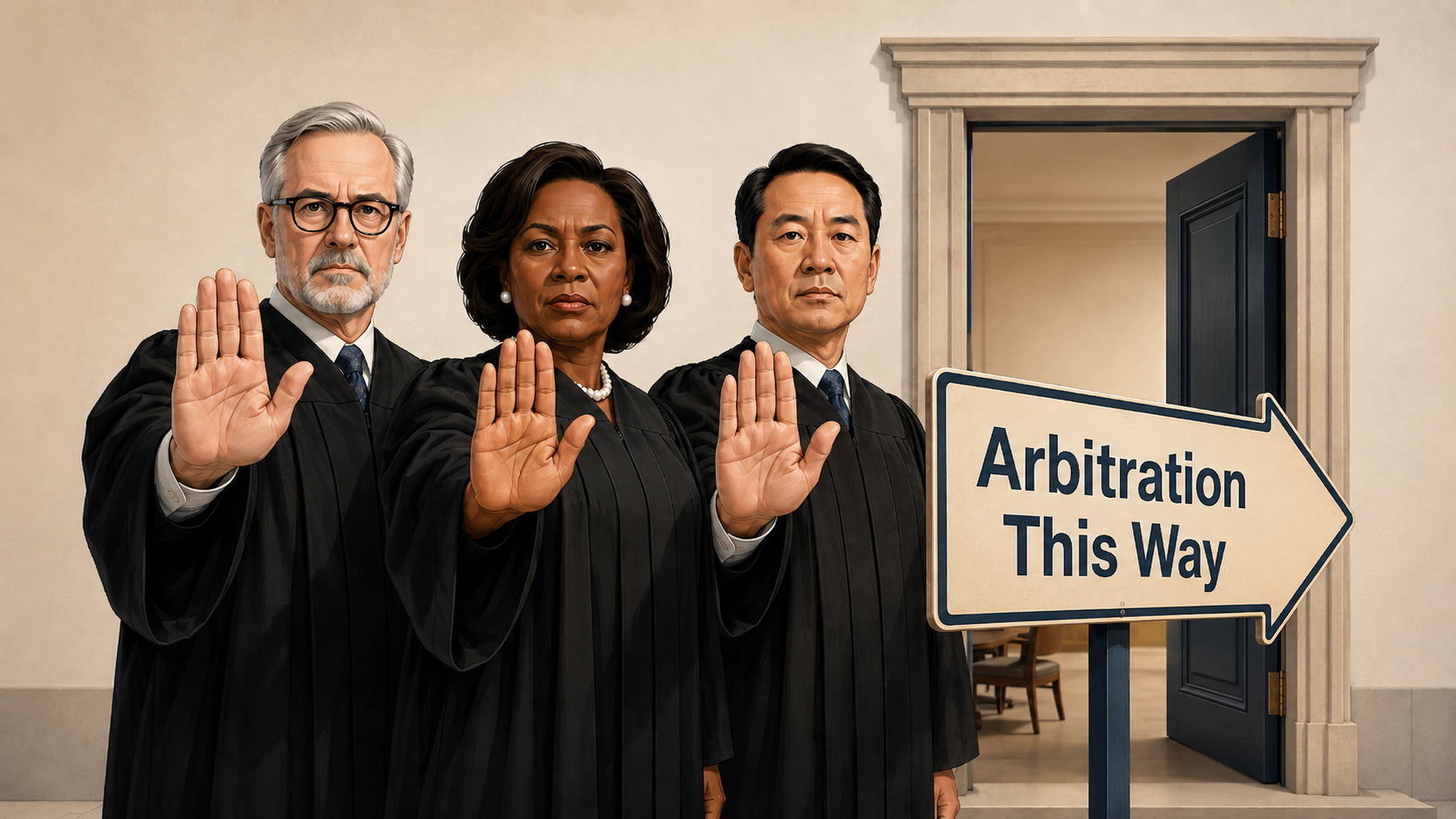
The Supreme Court declined to review the NFL’s effort to force Brian Flores’s discrimination claims into the league’s internal arbitral system. The denial of certiorari in National Football League v. Flores, No. 25‑790 (U.S. May 26, 2026), leaves standing a Second Circuit decision that treated the NFL’s process not as a poorly conducted arbitration, but as something outside the Federal Arbitration Act altogether.
The underlying claims involve Flores’s allegations of systemic racial discrimination in NFL hiring practices, including sham interviews conducted to satisfy the “Rooney Rule” after hiring decisions had already been made. The NFL went to court to compel arbitration under league provisions placing Commissioner Roger Goodell at the center of the dispute-resolution process.
The Second Circuit’s Approach
The Second Circuit did not treat the case as a challenge to arbitrator bias. Courts often enforce arbitration agreements despite allegations that arbitrators may favor repeat players or industry insiders. Under the Federal Arbitration Act, claims of evident partiality are ordinarily addressed later through motions to vacate an award.
The Second Circuit instead concluded that the NFL’s arrangement lacked the basic characteristics of arbitration protected by the FAA. Goodell was not merely an industry arbitrator. He was the league’s chief executive officer, representative of the organization being sued, procedural gatekeeper, and designated adjudicator of Flores’s claims. The court described the arrangement as “arbitration in name only.”
The opinion also relied on the effective‑vindication doctrine. That doctrine says that arbitration may be required for federal statutory claims only if the claimant can still effectively assert the federal right in the arbitral forum. See Mitsubishi Motors v. Soler Chrysler-Plymouth, 473 U.S. 614 (1985). The Court reasoned that that Flores could not realistically pursue federal discrimination claims in a process controlled by the opposing party.
The NFL’s Petition
The NFL’s cert petition framed the decision as a departure from modern arbitration law. The league argued that the Second Circuit improperly created a threshold inquiry into whether a proceeding is sufficiently “arbitral” to qualify for FAA protection.
The petition emphasized that the FAA already contains mechanisms for addressing arbitrator bias through post-award review under Section 10. According to the NFL, the Second Circuit improperly bypassed that framework by refusing to enforce the agreement before arbitration even occurred.
The league also warned that the decision could destabilize specialized and industry-based arbitration systems in which parties knowingly select adjudicators with institutional affiliations or repeat-player relationships. Finally, the petition argued that the Second Circuit expanded the effective-vindication doctrine beyond existing Supreme Court precedent.
Where the Case Leaves Arbitration Law
The Supreme Court did not endorse the Second Circuit’s reasoning. A denial of certiorari carries no precedential force. But it did not reject it either. That has some practical consequences.
The Second Circuit opinion now remains controlling authority within one of the country’s most important commercial circuits. Challengers of insider-controlled dispute systems will cite it. Organizations relying on executive-controlled arbitral structures will face increased scrutiny over whether the proceeding functions as genuine adjudication or simply as a contractual extension of one party’s authority.
In short . . .
Arbitration doctrine strongly favors enforcement of customized dispute mechanisms, but arbitration still depends on the presence of a neutral decision-maker. The Second Circuit concluded that the NFL crossed that line. And the Supreme Court, at least for now, has declined to say otherwise.