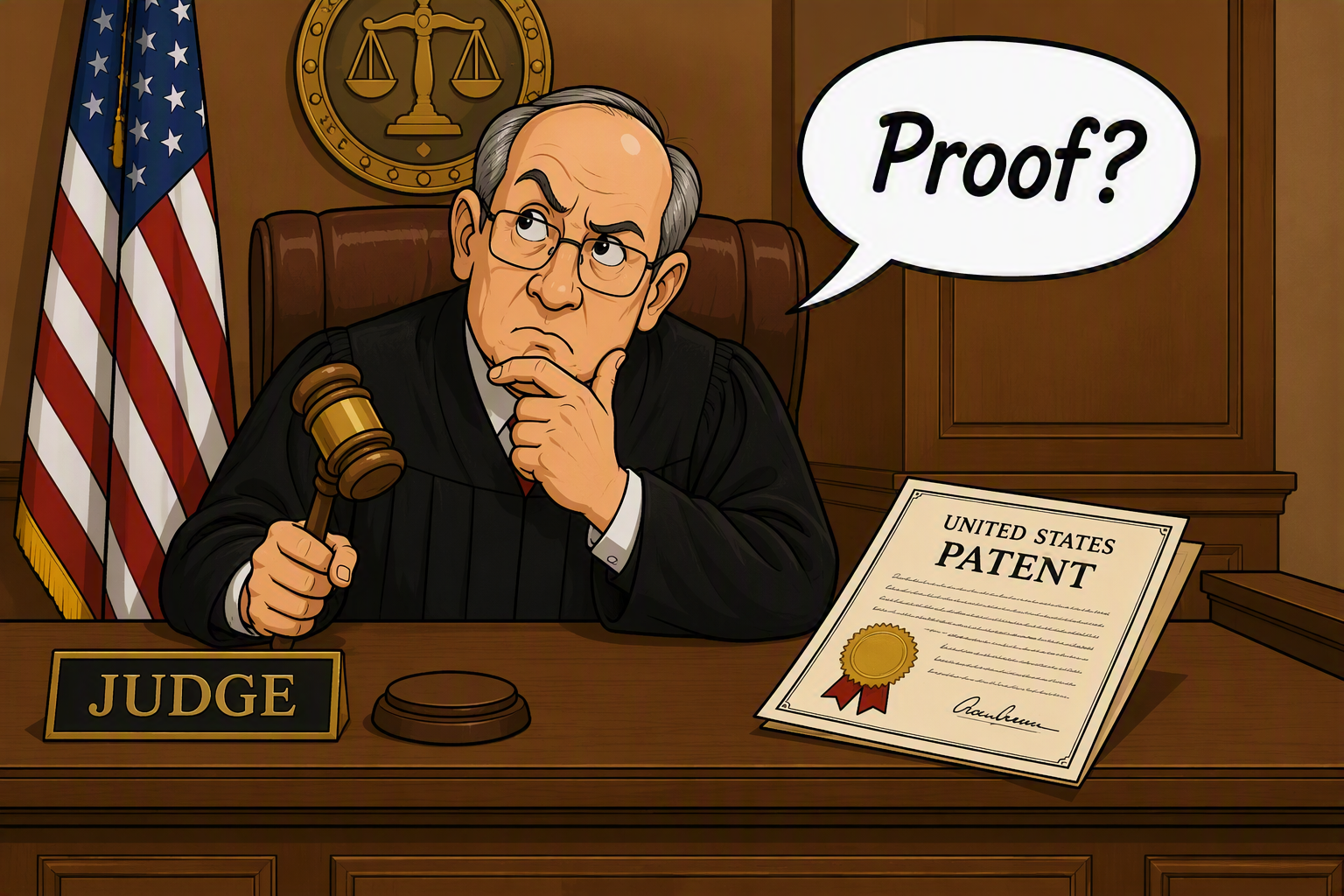
Imagine this. You represent a patent owner. You proved infringement and won at trial. The defendant is selling a product that infringes your patent. So, you get an injunction, right? Not necessarily.
Enter eBay
That used to be a pretty good assumption. Then the Supreme Court decided eBay Inc. v. MercExchange, L.L.C., 547 U.S. 388 (2006). The Court rejected the Federal Circuit's "general rule that courts will issue permanent injunctions against patent infringement absent exceptional circumstances." Instead, it held that a patent owner seeking an injunction "must satisfy a four-factor test before a court may grant such relief" and that "[t]hese familiar principles apply with equal force to disputes arising under the Patent Act." Id. at 391, 394.
So, the Court refused to presume irreparable harm from infringement just because the case involved a patent. As the Court put it, "[a] major departure from the long tradition of equity practice should not be lightly implied." Id. at 391.
Twenty Years Later, Some Plaintiffs Still Hadn’t Gotten the Message. They Will Now
That brings us to Wonderland Switzerland AG v. Evenflo Co., Inc., Nos. 2023-2043, 2023-2233, 2023-2326, slip op. (Fed. Cir. Dec. 17, 2025). The case involved patents covering child car seats. Wonderland won an infringement verdict and persuaded the district court to enter a permanent injunction. But, on appeal, the Federal Circuit took a hard look at the record and concluded that the proof of irreparable harm simply was not there.
The court began with a reminder: "Injunction is 'a drastic and extraordinary remedy, which should not be granted as a matter of course.'" Wonderland, slip op. at 13 (quoting Monsanto Co. v. Geertson Seed Farms, 561 U.S. 139, 165 (2010)). Injunctions are still available. But they are not automatic. If you want one, you have to prove you are entitled to one.
Show Me the Evidence
Wonderland argued that infringement harmed its competitive position, damaged product distinctiveness, and injured reputation. The Federal Circuit's response was essentially: That’s what they all say. Where is the evidence?
The court found no nonspeculative evidence that sales or market share had been lost to Evenflo rather than to the many other competitors in the market. It found no evidentiary support for findings that the accused products reduced the distinctiveness or market appeal of competing products. It found no evidence showing how alleged injury to Wonderland's business partner translated into irreparable injury to Wonderland itself.
The injunction could not stand because it "relied solely on speculative and conclusory evidence that Wonderland suffered, and would continue to suffer, irreparable harm or injury that could not be compensated with monetary damages." Wonderland, slip op. at 14.
"Might Think" Is Not Proof
The most interesting part of the opinion involves reputational harm. Wonderland pointed to testimony that if an Evenflo product had a problem, consumers "might think that's a technology problem." The Federal Circuit didn’t buy it. It labeled the evidence "speculative testimony" and said it did not establish irreparable reputational harm. More pointedly, the court said the testimony "certainly fails to show how such reputational harm flows to Wonderland." Id. at 16.
Patent plaintiffs often rely on what customers might think, what competitors might do, what could happen to reputation, or what may occur in the marketplace. After all, their concerns about that may well have been what led them to sue. Often those concerns are reasonable. But eBay requires proof, not possibilities. A concern about future harm - no matter how sincere and even reasonable - is not evidence of irreparable harm.
What Wonderland Means
Wonderland did not change injunction law. Instead, it shows that the Federal Circuit is willing to enforce eBay as written. Predictions, assumptions, and conclusory assertions won’t do. There must be evidence, just as eBay demanded twenty years ago.
What Kind of Proof Has Worked?
Courts have granted post-verdict patent injunctions when the patentee offered concrete, non-speculative evidence of competitive harm. Examples include:
· Direct competition, lost market share, lost revenue, brand recognition, and goodwill. In i4i Ltd. Partnership v. Microsoft Corp., 598 F.3d 831 (Fed. Cir. 2010), the Federal Circuit affirmed an injunction based on evidence that Microsoft and i4i competed directly and that infringement harmed market share, revenue, brand recognition, and customer goodwill.
· Direct competition, lost market share, lost customers, customer relationships, and price erosion. In Robert Bosch LLC v. Pylon Manufacturing Corp., 659 F.3d 1142 (Fed. Cir. 2011), the Federal Circuit reversed denial of an injunction where the record showed direct competition, lost market share, lost customers and customer relationships, and price erosion.
· Customer demand tied to the patented feature. In Apple Inc. v. Samsung Electronics Co., 809 F.3d 633 (Fed. Cir. 2015), the Federal Circuit found the causal-nexus showing sufficient for a feature-limited injunction where Apple presented evidence connecting the patented features to consumer demand, including survey, copying, and customer-demand evidence.
· Lost market share, brand injury, and reputation as an innovator. In Douglas Dynamics, LLC v. Buyers Products Co., 717 F.3d 1336 (Fed. Cir. 2013), the Federal Circuit vacated denial of an injunction where the record supported direct competition, lost market share, brand and reputational injury, and harm to the patentee’s reputation as an innovator.
In short, the proof that has worked is proof tied to actual marketplace effects: lost sales, lost market share, price erosion, lost customers, consumer demand for the patented feature, harm to goodwill or reputation, and evidence that money damages would not fully repair the injury.
And so . . .
The lesson of eBay was that irreparable harm is not presumed from patent infringement. The lesson of Wonderland is that the Federal Circuit expects district courts to take that seriously. Winning the infringement case is not enough. If you want the extraordinary remedy of an injunction, you have to prove entitlement to equitable relief just like in any other case.
Patent or not, no proof means no injunction.