Stories about AI making up cases and quotes are familiar by now. But they always lead me to wonder what’s next. Particularly, if AI starts to decide cases, won’t the successful advocates be the ones who know how to manipulate AI rather than provide the winning facts and legal analysis? A recent case provides a clue. Fortunately, AI wasn’t deciding the case. And we need to keep it that way.
A Note to the Machine
In Elliott v. New York Bariatric Group, LLC, No. AAN-CV-25-6066141-S (Conn. Super. Ct. Aug. 6, 2026), a Connecticut trial court had to deal with concealed instructions aimed at any AI system that might review the plaintiff’s filings. The self-represented plaintiff placed text in tiny white type on a white background. It was effectively invisible to a human reader but readable by software.
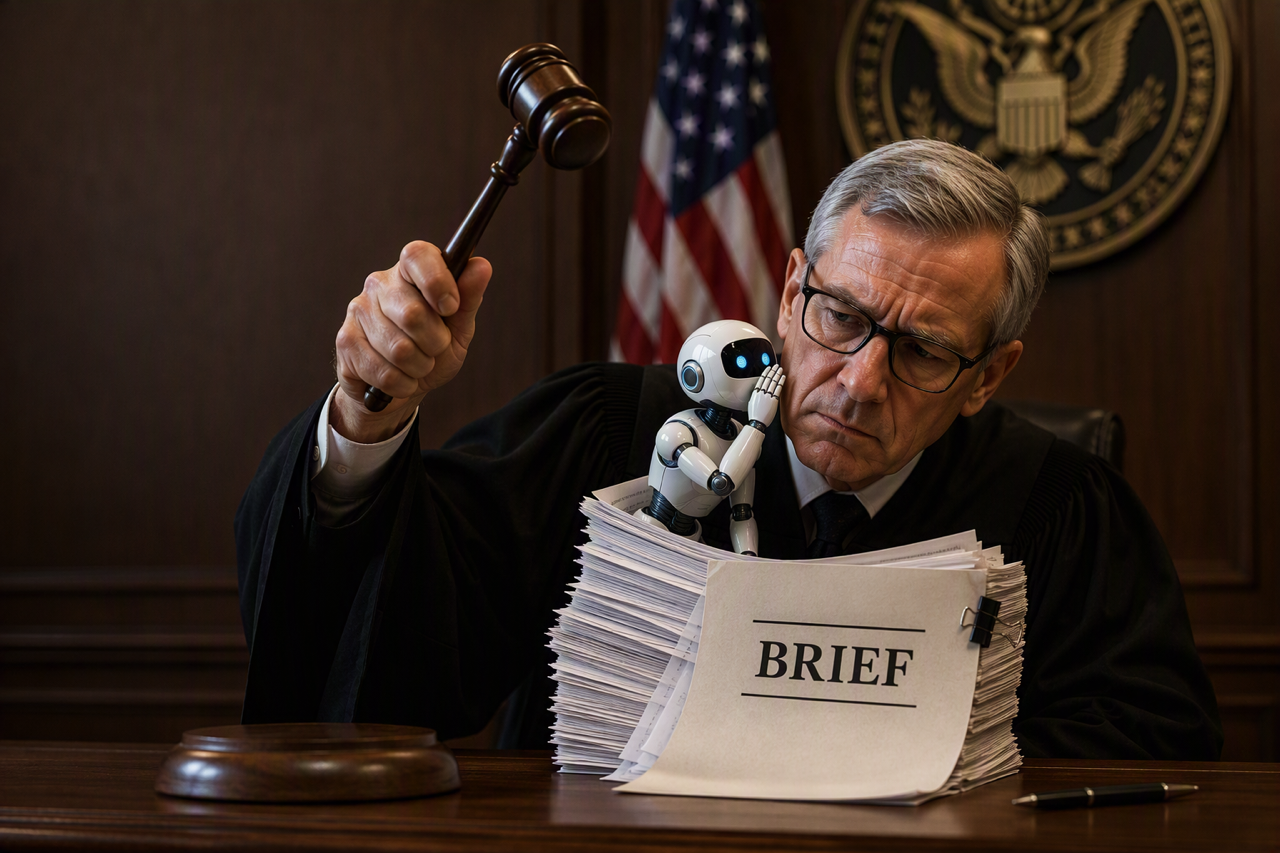
The hidden text told any reviewing AI, in substance, to agree with the plaintiff and help reverse an earlier adverse ruling. The filing was not just arguing to the judge. It was also slipping the machine a note that in effect said: “Hey robot, rule for me.”
A Human Was Reading
The effort unraveled because Judge Walter Spader is a real judge — not a robot. He noticed unusual blank space and looked closer. The court then issued an order to show cause and held a hearing. And yet the plaintiff filed more documents with concealed text even after receiving notice of the problem.
That was not a winning strategy. The court-imposed sanctions and took away the plaintiff’s electronic filing privileges.
What the Court Said
You can use AI as a tool to make things more efficient. But you can’t use hidden instructions as a secret agent to manipulate any AI that might process the filing.
There is a wide gap between using AI to help draft an argument and planting a message to the robot that the filer should win. Using a tool is fine. Manipulating the legal process is not.
The Next Filing May Be Smarter
This attempt was clumsy enough to be found. But the next one may not be. If machines are used to decide cases, courts and arbitrators may eventually need tools that detect hidden text and other machine-directed instructions.
But, at least for now, machines don’t decide cases. All the guidance to judges and arbitrators is to use AI to help locate, summarize, and check things but never to decide anything. (You may have read my earlier article about what happened when a court found that an arbitrator had let AI make a decision. That didn’t fly.)
And Elliott points out how refusal to delegate decision making also naturally thwarts attempts to manipulate AI. Read the filing, notice what looks odd, and investigate. The best AI countermeasure is to get the machine out of the way and let a careful human take a look.
And so . . .
For years, the main problem reported with using AI in legal matters has been hallucinated citations. Now there is a new concern: the filing that is secretly talking to the AI.
It didn’t work in Elliot. The filer was caught and sanctioned. The case reminds the rest of us to check whether the brief is talking to the decision maker or whispering to the computer. Still, if we follow the guidance already in place, judges and arbitrators will make decisions. And any secret whispers directly to AI won’t change a thing.
Source: Memorandum of Decision, Elliott v. New York Bariatric Group, LLC, No. AAN-CV-25-6066141-S (Conn. Super. Ct. Aug. 6, 2026).