California’s New Law on AI in Court and Arbitration
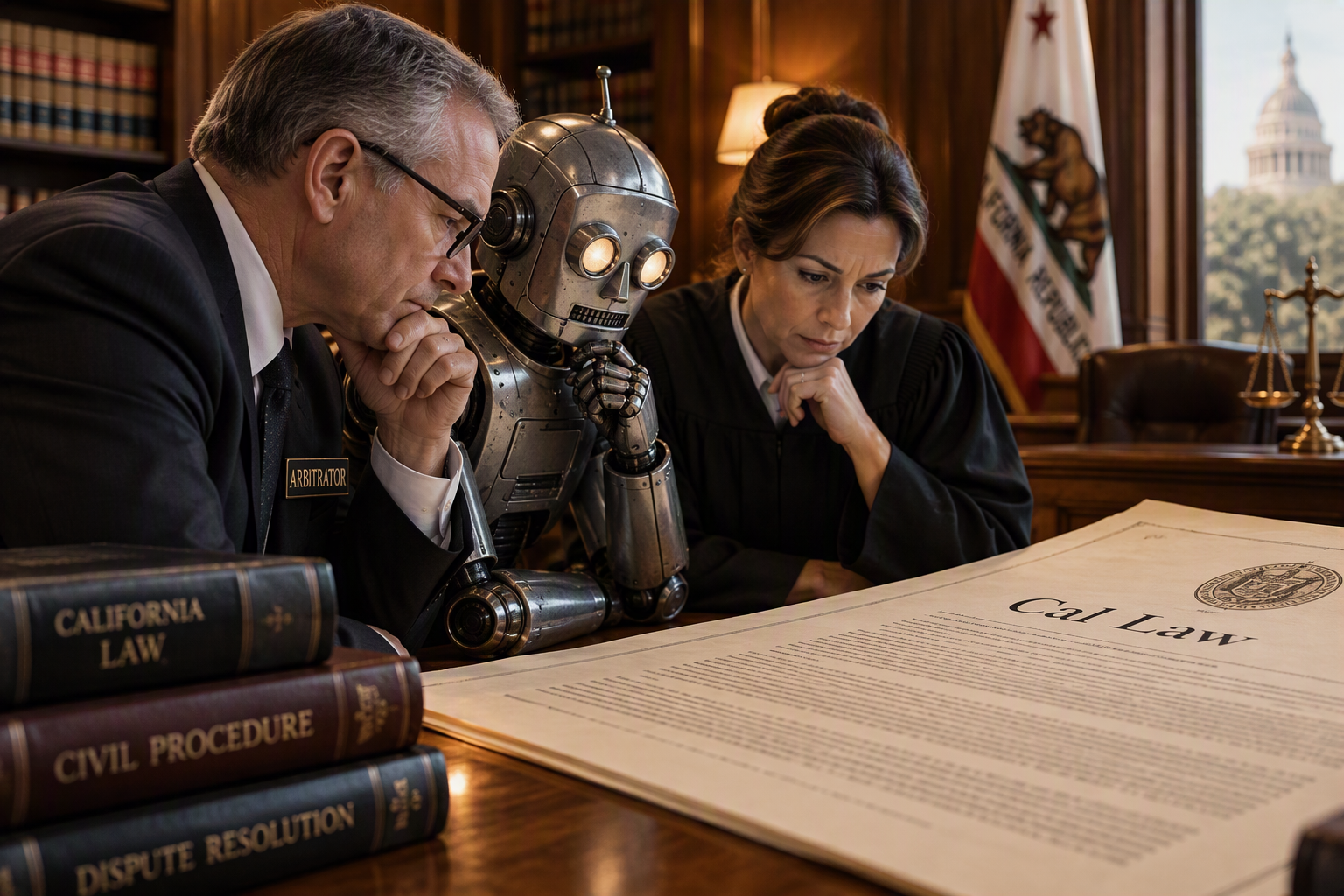
If you’re like me, you are probably a little tired of hearing about AI all the time. AI hallucinating cases. Lawyers getting in trouble with the court for not checking up on AI output. Courts getting found to use it incorrectly. And so on.
Still, you aren’t going to get away from AI in litigation and arbitration. Many find it a useful tool. I am sure some find it indispensable by now. So, we need to keep track of it. Let’s have a look at what California is up to in that regard.
It was probably only a matter of time. California has now taken many of the developing rules for using generative AI in legal work and written them into a statute. Governor Newsom signed Senate Bill 574 on September 30, 2026. It was filed the same day as Chapter 858 and takes effect January 1, 2027.
Most of the bill shouldn’t be a surprise. It’s provisions affecting arbitrations will be familiar to those following guidance on AI in arbitration like the Silicon Valley Arbitration and Mediation Center’s Guideline on use of AI. And various court orders and bar recommendations have laid out guidance remarkably similar to this statute. But they weren’t laws.
Lawyers Still Have to Be Lawyers
The new law says a lawyer cannot delegate the practice of law to generative AI. A lawyer using it must protect confidential and nonpublic information, reasonably verify the output, including case and statutory citations, and correct errors and hallucinations. No surprise there. If AI might help write the brief, but the lawyer owns the brief.
Giving Notice
The statute also requires disclosure of AI use for documents submitted to a court. But the language is sparse. It says only says lawyers must "[d]isclose the use of generative artificial intelligence to the court for all documents submitted to the court and consider whether to disclose the use of generative artificial intelligence if it is used to create content provided to the public. How detailed that disclosure needs remains to be seen. And lawyers will need to be careful not to create privilege and work product waiver issues in making the required disclosure. Folks have until January 1, 2027, to figure all that out.
But what about notice in arbitration? The statute says, “disclose . . . to the court.” It does not specifically require a lawyer to disclose AI use in a brief submitted only to an arbitrator.
Of course, an arbitrator can address that issue in a scheduling or procedural order. The SVAMC Guidelines even include a model clause for procedural orders, while stating that disclosure is not necessary as a general matter and should be considered case by case.
Arbitrators Still Have to Arbitrate
The arbitrator provisions of the new statute preserve the duties of neutrality, competence, and diligence. Most importantly, they prohibit an arbitrator from delegating any part of the decision-making process to an AI tool.
The statute also says an arbitrator may not rely on AI-generated information outside the record without first making a disclosure and, as far as practical, allowing the parties to comment. The statute is silent on disclosing general use of AI by an arbitrator.
The statute does not ban use of AI. AI can help. It just cannot become the arbitrator. If you’ve read my earlier articles about arbitrator’s use of AI, that will be familiar to you.
Effect of the Law in Arbitration and Outside California
Most commercial arbitration agreements involving interstate commerce are governed by the Federal Arbitration Act, not California arbitration procedure. So, the new law will won’t govern most commercial arbitrations.
Still, it is worth noting that California has codified principles already reflected in the 2024 SVAMC and other guidelines: protect confidentiality, understand the tool, verify the output, preserve due process, and do not delegate the arbitrator’s personal mandate.
The SVAMC Guidelines do go a little further on disclosure. They say disclosure of AI use by the arbitrator is not generally necessary, but the question should be decided case by case, with due process and privilege in mind. The California statute does not address disclosures by the arbitrator except for use of AI-generated information outside the record.
Where This Leaves Us
California is not trying to ban AI from legal practice or arbitration. It is putting responsibility where it has always been. The lawyer is responsible for the work, and the arbitrator is responsible for the decision.
Most lawyers and arbitrators already understand this. But codifying it into a state law will help make this common-sense approach the norm. You can expect other states to follow California’s lead.
Sources
California Senate Bill 574, Chapter 858, chaptered text
California Secretary of State, Bill Chapters and effective-date explanation
SVAMC Guidelines on the Use of Artificial Intelligence in Arbitration (2024)