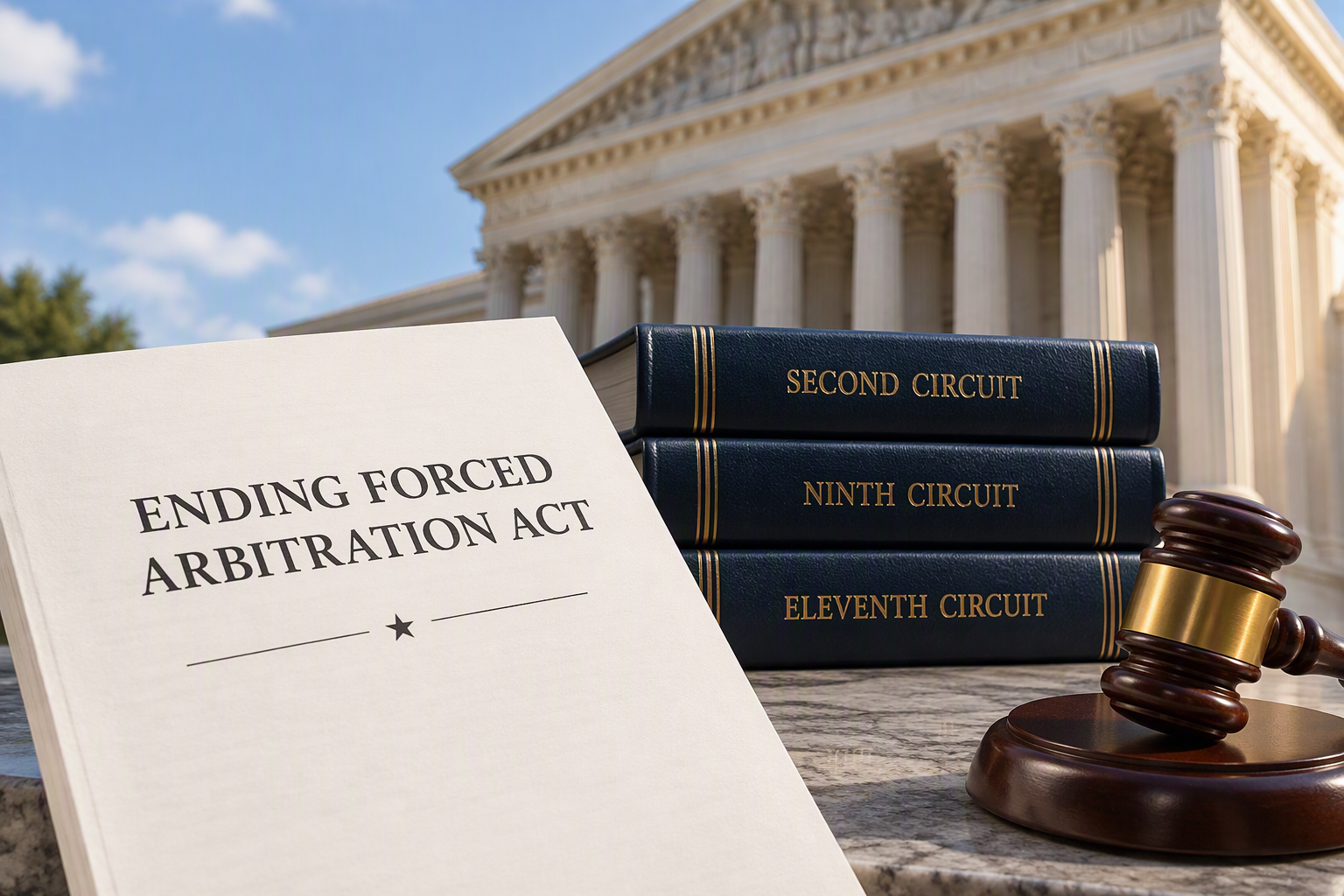
Three federal courts of appeals have now said the Ending Forced Arbitration Act means what it says: when the Act applies, the whole case stays in court.
A statutory dispute can come down to one word. Today’s word is “case.”
Congress could have said “claim” when it passed the Ending Forced Arbitration of Sexual Assault and Sexual Harassment Act (EFAA). But it didn’t. Instead, it said that a pre-dispute arbitration agreement is not enforceable, at the claimant’s election, “with respect to a case” that relates to a sexual-assault or sexual-harassment dispute. [Emphasis added.]
The Second Circuit understands a claim to be just one part of a lawsuit, and a case is the lawsuit. So, it joined the Sixth and Ninth Circuits in holding that, when the Act applies, the arbitration agreement is unenforceable as to the entire case, not just the sexual-harassment claim. This is starting to be a trend in the circuits.
The Act
The EFAA, became law on March 3, 2022. It added Chapter 4 to the Federal Arbitration Act. The core provision is 9 U.S.C. § 402(a). That allows a person alleging sexual-assault or sexual-harassment to elect not to enforce a predispute arbitration agreement “with respect to a case” filed under federal, tribal, or state law that relates to that dispute.
Congress decided that a person asserting sexual assault or sexual harassment should not be forced into a private forum by an agreement made before the dispute arose. But what happens to the other claims in the complaint?
Suppose, for example, an employee brings a sexual-harassment claim together with wage, contract, disability, retaliation, or tort claims. Is the court supposed to keep the harassment claim and send everything else to arbitration? Or does the statute keep the whole dispute in court?
Early days
The first reported decisions did not all read the statute the same way.
In Johnson v. Everyrealm, Inc., the Southern District of New York did read “case” to mean the entire lawsuit. Once the plaintiff plausibly alleged a sexual-harassment dispute covered by the Act, the court refused to compel arbitration of the other claims as well.
But in Mera v. SA Hospitality Group, LLC, 675 F. Supp. 3d 442, 448 (S.D.N.Y. 2023), the Magistrate Judge went the other way. The court didn’t believe that putting one harassment claim in a group of claims that were far afield of sexual harassment should move the whole dispute to court. But the decision was later reversed by the district court based on the statutory language. Mera v. SA Hospitality Group, LLC (S.D.N.Y. Nov. 15, 2025).
Still, the case seemed to raise the possibility that another court might also see it the way the New York magistrate did. After all, could Congress really have meant just asserting a harassment claim, even if baseless, could move the whole case — which might really be primarily focused on wage and hour issues or matters unrelated to alleged harassment— from arbitration to court? Wouldn’t this provide a convenient path to use creative pleading to do an end run around the Congress’s protection of the contracts to arbitrate embodied in the Federal Arbitration Act?
The Sixth Circuit Goes First
The first federal appellate decision squarely addressing the point was Bruce v. Adams & Reese, LLP, 168 F.4th 367 (6th Cir. 2026). The plaintiff asserted a Title VII sexual harassment claim along with Americans with Disabilities Act claims. The employer accepted that the harassment claim could not be forced into arbitration but argued that the ADA claims still belonged there.
The Sixth Circuit disagreed. The majority held that the EFAA barred arbitration of the plaintiff’s entire case. Judge Thapar dissented. He thought that the majority ignored the strict pleading standard for hostile-workplace claims and credited vague, conclusory allegations—all to let a plaintiff avoid a valid arbitration agreement.
So, the issue did not look entirely settled. But still, the first court of appeals to decide the question chose the whole-case reading.
The Ninth Circuit Agrees
A few months later, the Ninth Circuit decided Ding v. Structure Therapeutics, Inc., No. 25-1532 (9th Cir. Aug. 19, 2026). There the plaintiff had already begun arbitration and had been in that forum for over a year. During discovery, she said she learned facts supporting a sex-based harassment claim. She withdrew from arbitration and filed in court. The Ninth Circuit held that she could invoke the EFAA after discovering the basis for the covered claim. Importantly, the court allowed her to pursue her claims in court rather than slicing the proceeding into separate forums.
Judge Rawlinson dissented, believing that plaintiff’s election to abandon arbitration came too late in the process.
Then the Second Circuit
The Second Circuit’s September 30, 2026, decision in Diaz-Roa v. Hermes Law, P.C., No. 24-3223-cv, again resolved the claim-versus-case issue.
Silvia Diaz-Roa worked for Hermes Law and later performed work for an affiliated litigation-management company. She had signed a broad arbitration agreement. Her lawsuit included sexual-harassment claims, but it also included a conversion claim concerning stock options. The defendants argued if the harassment claims stayed in court, the conversion claim should go to arbitration.
The Second Circuit rejected that argument, reasoning that a “claim” is an individual demand for relief. A “case” is the lawsuit as a whole. Congress used “case” in § 402(a), and it used “claim” elsewhere in the legislation. Courts generally assume Congress is making a distinction when it chooses different words.
The court therefore held that, when the EFAA applies, a plaintiff may invalidate the predispute arbitration agreement as to the entire lawsuit, including claims that do not themselves allege sexual harassment or sexual assault.
So Far: Three Circuits, One Answer
We now have three federal courts of appeals pointing in the same direction. But that is not yet every circuit. And two of the three appellate decisions drew dissents. So, it is still possible that another court of appeals will see the statute differently. Still, a majority of appellate judges facing the issue have found the plain meaning of that statute compels the result because a case is not a claim.
Will Other Circuits Follow?
Probably. The textual argument is strong because it comes from the plain meaning of the text. Courts do not have to infer a broad congressional purpose or stretch an exception to the FAA. They only have to give the word “case” its ordinary meaning. If you follow the U.S. Supreme Court you know that "textualism" has become a common approach to statutory construction thanks in large part to Justice Scalia. Textualism doesn't ask, "What did Congress's intend?" but rather, "What did Congress say?"
The argument on the other side has some practical appeal, though. Why should one harassment claim displace arbitration of unrelated contract or statutory claims that the parties plainly agreed to arbitrate? And what prevents clever gamesmanship in pleading to move an otherwise arbitrable dispute into court?
Those are real concerns. But they may be concerns for Congress, not reasons for a court to substitute “claim” for “case.” Congress amended the FAA itself. The usual federal policy favoring arbitration cannot override an exception that Congress placed directly into that statute.
Coming Up
If the whole case moves to court, the next question becomes more important: what must the plaintiff show to trigger the Act? Must the complaint merely contain a nonfrivolous allegation of sexual harassment? Must it state a plausible claim under Twombly and Iqbal? And when should the court decide that question? That fight showed up early on in the Sixth Circuit case, leading one judge to dissent.
And Diaz-Roa did not resolve the pleading-threshold issue because the defendants had not preserved it and did not dispute that the allegations met the higher plausibility standard. That all leaves room for further argument and appellate development.
And So
At least for now, you should not assume a court will sever the EFAA claim and compel arbitration of the rest. In the Second, Sixth, and Ninth Circuits, the appellate answer is now the opposite. But be on the look out for gamesmanship in pleading to avoid a valid arbitration agreement. Court are likely to be receptive to an attack on such gamesmanship.
Authorities and Links
· Bruce v. Adams & Reese, LLP, 168 F.4th 367 (6th Cir. 2026)
· Ding v. Structure Therapeutics, Inc., No. 25-1532 (9th Cir. Aug. 19, 2026)
· Diaz-Roa v. Hermes Law, P.C., No. 24-3223-cv (2d Cir. Sept. 30, 2026)
· Johnson v. Everyrealm, Inc., 657 F. Supp. 3d 535 (S.D.N.Y. 2023)
· Mera v. SA Hospitality Group, LLC, 675 F. Supp. 3d 442, 448 (S.D.N.Y. 2023)
· Mera v. SA Hospitality Group, LLC, No. (Nov. 15, 2025 (S.D.N.Y. 2023)