A Halloween lesson in claiming the thing, the system, and the steps
Today, let’s return to patent law. It can get pretty dense. But it is important, and it will become even more important as technology zooms ahead. So, any clear, and fun, explanation of basic patent principles is welcome.
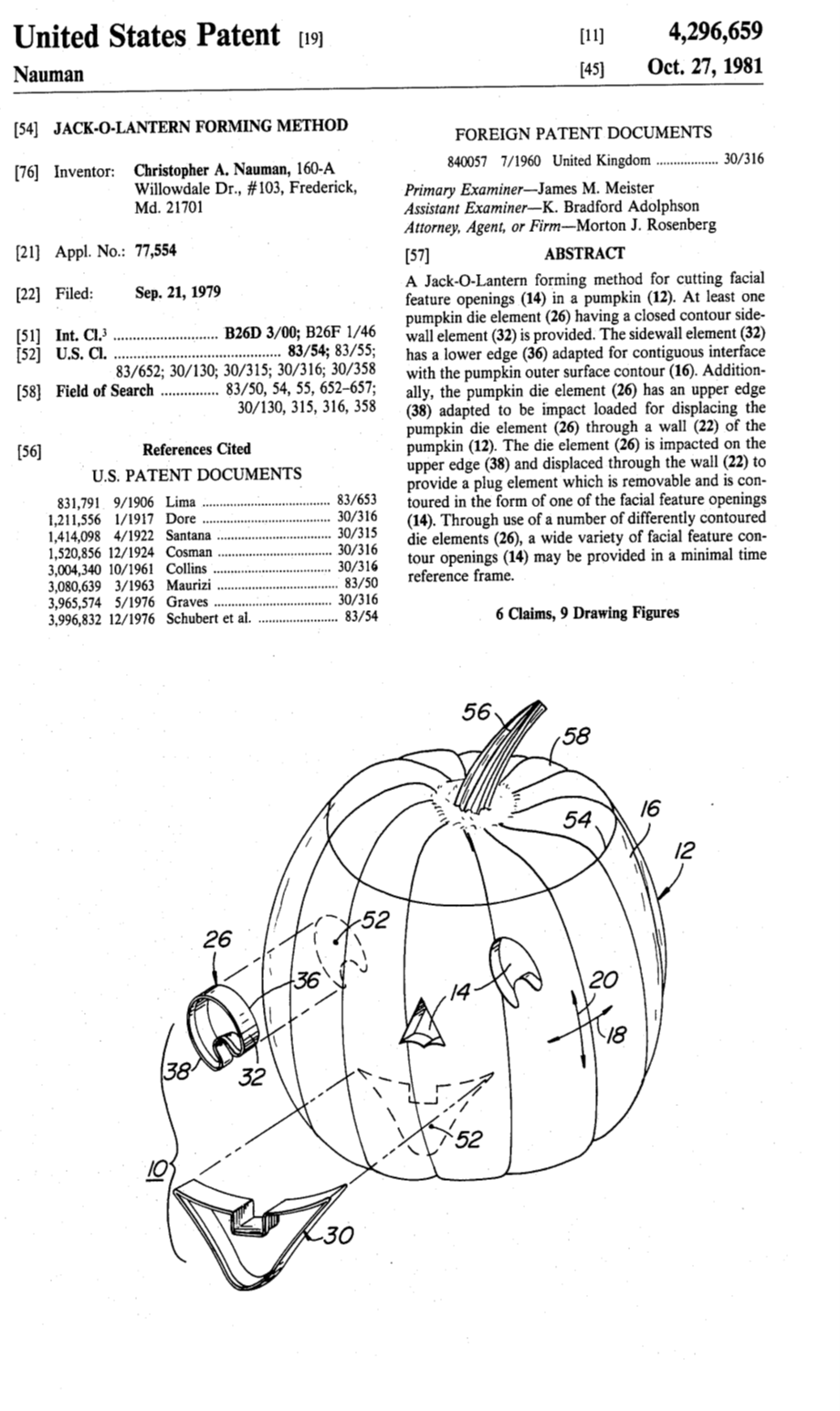
I recently came across a particularly good one, inspired by Halloween. Patent lawyer Puya Partow-Navid uses an actual patent on a method for carving a jack-o’-lantern to explain the difference among several kinds of patent claims. Read the full article here.
It’s worth reading the whole article, and I hope you do. If you do, you can stop reading this article now. But you’re probably busy, so until you get around to it, here is a quick summary.
The Pumpkin Patent
The patent is U.S. Patent No. 4,296,659, “Jack-O-Lantern Forming Method.” It describes placing a die shaped like an eye, nose, or mouth against a pumpkin and striking it with a mallet. Think of a cookie cutter for pumpkins, but with more banging.
The important thing is what the first claim protects. It does not claim the die itself but instead claims a method of forming a jack-o’-lantern. That makes the pumpkin a useful way to distinguish three common claim types:
· Apparatus claim: protects the thing itself, such as the cutting die.
· System claim: protects multiple components working together.
· Method claim: protects a series of steps used to accomplish a result.
The pumpkin method includes providing the die, positioning it, striking it, and driving it through the pumpkin wall. The claim protects the how, one step at a time.
Why the Claim Type Is Important
Every required step generally must be performed for literal infringement of a method claim. (Let’s not complicate all this with the doctrine of equivalents. That may be another article some day.) If a required step is skipped, the accused conduct falls outside the claim’s words. The result? No infringement.
But who performs the steps? With the pumpkin patent, the direct infringer may be the person carving the pumpkin rather than the company selling the dies. A claim against the seller may require an indirect-infringement theory, such as inducement. That is to say, “the instructions from the seller told the buyers to do it, so they did.”
Things get even trickier when the steps are divided. If one person holds the die and another swings the mallet, no single person has necessarily performed the entire method. That raises divided-infringement questions about whether one person’s acts can legally be attributed to the other. That is complicated but there is plenty of law on it to work through.
Drafting Patents
A careful patent drafter looks at an invention from several directions. Can the patent claim the device, a system containing it, a method of using it, or a kit of components? Different claims may provide different paths to enforcement, and relying on only one type can leave a gap. Patent drafters try to avoid that gap.
Pumpkins are pretty easy, but the same principles apply to more complicated inventions. In software, wireless communications, and AI, the inventive feature may lie less in what a product is than in what it does and how it does it. Method claims can therefore carry much of the load, but only if the drafter thinks carefully about the claimed steps and who will perform them.
So, the next time someone wants you to explain how the different types of patent claims work, hand them a pumpkin and a mallet. If the lesson does not stick, at least you’ll get Halloween decorations done.
Thanks to Puya Partow-Navid for making understanding patents fun.