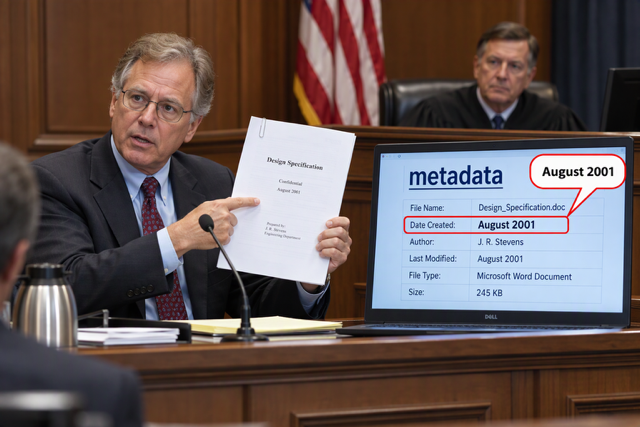
The Federal Circuit says computer-generated metadata can independently corroborate an inventor's testimony.
In Google LLC v. Valtrus Innovations Ltd., the Federal Circuit decided an interesting evidence question in a patent case: Can Microsoft Word metadata corroborate an inventor's testimony about when something happened? The court said yes.
The patent at issue claims methods and computer readable memory for credible search-result lists form several search engines. Google went before the Patent Trial and Appeal Board to try to invalidate the patient based on prior art. It lost. The evidence question noted above is why. Let’s have a look.
First, a Little Ancient Patent Law
This case arose under the patent law that existed before the America Invents Act. Under old § 102(e), another person’s U.S. patent application could count as prior art as of its filing date, even though the public did not see it until the application was published or the patent issued.
That filing date was not always the end of the story. Suppose Google found a patent application filed in July and used it against Valtrus. Valtrus could answer, “They filed first, but we invented before they filed.” If Valtrus proved an earlier invention under the old priority rules, the July filing would no longer be prior art against Valtrus. Patent lawyers called that “swearing behind” the reference, or — a little more eloquently —- antedating it.
Google relied on an earlier-filed patent called Bushee. Valtrus said its inventors had conceived their invention before Bushee’s filing date and offered the additional priority proof the old rules required. If Valtrus proved that earlier invention, Bushee dropped out as § 102(e) prior art, and Google’s challenge based on Bushee failed.
But You Can't Just Say, “Trust Me, I Thought of It First”
That would make priority too easy to manipulate. Years later, an inventor whose patent is in trouble has every incentive to remember the breakthrough as happening just a little earlier. I’m no psychologist, but I have noticed some people have a tendency to remember things in their favor when they are embroiled in a legal dispute. So, apparently, have courts called upon to decide patent disputes.
So, the law requires corroboration of an inventor's testimony about conception. Valtrus could not simply offer an inventor who said, “Yes, I remember inventing this before Bushee.” It needed independent evidence supporting that account.
Valtrus’s evidence was invention-disclosure documents. Google argued that those documents were not sufficiently independent because they were the inventor's own documents. But the files contained something else: metadata automatically generated by Microsoft Word.
Enter Microsoft Word
The metadata included authorship and timestamp information that verified the inventor's account. The inventor did not write that information into the document. Word generated it automatically.
The Federal Circuit thought that made all the difference, noting, “Microsoft Word metadata can provide independent corroboration of inventor statements and documents contained in Word files.” The document was the evidence created by the inventor. But the automatically generated metadata was not and so could independently support his story.
So, does metadata always guarantee the evidence is sufficient? No. The court assumed without deciding that the metadata was authentic. Authentication remains a separate question.
And So?
The case applies the old first-to-invent law. The America Invents Act’s first-to-file provisions took effect on March 16, 2013. But still, old-law cases have not vanished. A utility patent ordinarily expires 20 years after its U.S. filing date (although exceptions and other provisions of can complicate this). And patent-term adjustments or extensions can move the expiration date even later. So, plenty of pre-AIA patents are still around.
But more important is this: a document and its metadata are not necessarily the same evidence. When timing is important, get the native file. Documents may tell you what inventors say they did. But the native file may prove it.
The role of metadata was particularly important in this case because of the need to corroborate inventor testimony. But the evidentiary precedent reaches further than this case. Remember, the point is not only to get information into evidence. Evidence must be persuasive. And the now-established role of Word metadata as corroborating the very document containing it could be persuasive indeed in the right case. But remember, you may also need to prove the accuracy of the metadata.
So, sometimes your best corroborating witness may be Microsoft word — not a person. After all, it has no interest in the outcome of the dispute.
Authority: Google LLC v. Valtrus Innovations Ltd., No. 2024-1945 (Fed. Cir. Oct. 19, 2026), precedential. Federal Circuit opinion