A Reminder on “Exceeding Powers”
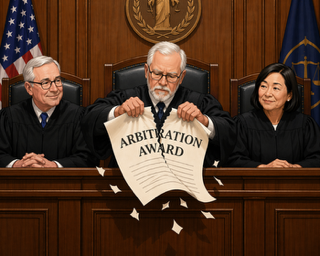
As arbitration becomes a more common way of resolving disputes, losing parties inevitably work their way to the courts to try to undo a result they do not like. Courts are typically resistant to this. The main point of the Federal Arbitration Act is to uphold parties’ contracts to resolve disputes by arbitration. By contracting to resolve disputes arbitration, parties to make things faster and cheaper, they gave up what often feels like an unending amount of review on appeal and otherwise. Recognizing that tradeoff, the Federal Arbitration act is deferential to arbitrators’ decisions, allowing awards to be vacated only on limited grounds.
I recall speaking at a CLE on arbitration together with a skilled corporate counsel. As I was about to go over ground for overturning arbitration awards, he summed up overturning arbitration awards this way: “You can’t.”
While that is often true, things are a little more nuanced than that. Courts’ deference to arbitrators is not unlimited. And one thing the FAA — and therefore the courts — will not allow is an arbitrator exercising power the parties did not give him or her. See 9 U.S.C. Section 10(a)(4).
The Case
Which brings us to USAA Savings Bank v. Goff, No. 25-1730 (7th Cir. Mar. 19, 2026). A consumer dispute went to arbitration, and the arbitrator awarded $10,000 in punitive damages. The arbitration agreement, however, had a specific requirement. Punitive damages awards were subject to a post-award review process before they became final. The arbitration provision said:
Before the decision [to award punitive damages] becomes final, the arbitrator must also conduct a post-award review of any punitive damages, allowing the parties the same procedural rights and using the same standards and guidelines that would apply in a judicial proceeding in the state where the arbitration is located. Any ruling based on this post-award re-view must be set forth in writing with a reasoned explanation.
That requirement was part of the process the parties agreed would govern this type of relief.
What Happened
The arbitrator issued the award and treated it as final without using that process. The district court confirmed the award, applying the familiar and highly deferential standard of review. The Seventh Circuit reversed.
Why It Matters
The court did not vacate the award because it disagreed with the arbitrator’s reasoning or thought the damages were too high. Those arguments, even if correct, probably would not get a losing party very far. Instead, the court focused on the power the parties did and so not give to the arbitrator. The arbitrator exercised power to award punitive damages without going through the required steps.
The Line Courts Enforce
That is exactly where § 10(a)(4) of the Federal Arbitration Act comes into play. Courts will uphold an award so long as the arbitrator is at least arguably construing the contract. That is a forgiving standard by design. It allows room for error because the parties bargained for the arbitrator’s judgment, not judicial second-guessing.
But that standard has limits. If the arbitrator is not applying the contract at all—in this case by bypassing a required procedure—then the arbitrator is no longer exercising the authority the parties delegated. At that point, the problem is not that the arbitrator got it wrong. The problem is that the arbitrator did not follow the job description the parties laid out.
Application in Goff
That is what the Seventh Circuit saw in Goff. There was no attempt to interpret the punitive-damages review provision and apply it in a way one side might dispute. The arbitrator just skipped a step. Once that happens, the usual deference does not resolve the case. The court then is not reviewing the merits; it is enforcing the contract.
Practical Takeaway
Arguments that an arbitrator made a legal or factual mistake rarely succeed, no matter how strong they appear. [1] But arguments that identify a specific contractual requirement and show the arbitrator didn’t follow often succeed. They do not ask the court to reweigh the case. They ask the court to ensure that the arbitrator stayed within the authority the parties granted.
_______________
[1]That isn’t always the case though. In an earlier article, I discussed a cases where the decision seemed so far off to a court that it found a way to undo it, even though the decision appeared to just be an erroneous legal decision.. See https://daveadr.com/blog/ninth-circuit-to-arbitrator-you-cant-do-that-even-here-in-arbitration-nation discussing Aspic Engineering & Construction Co. v. ECC Centcom Constructors, LLC, 913 F.3d 1162 (9th Cir. 2019).