Congress opened the courthouse door, but how far? Cases, claims and the ending forced arbitration of sexual harassment and assault claims act
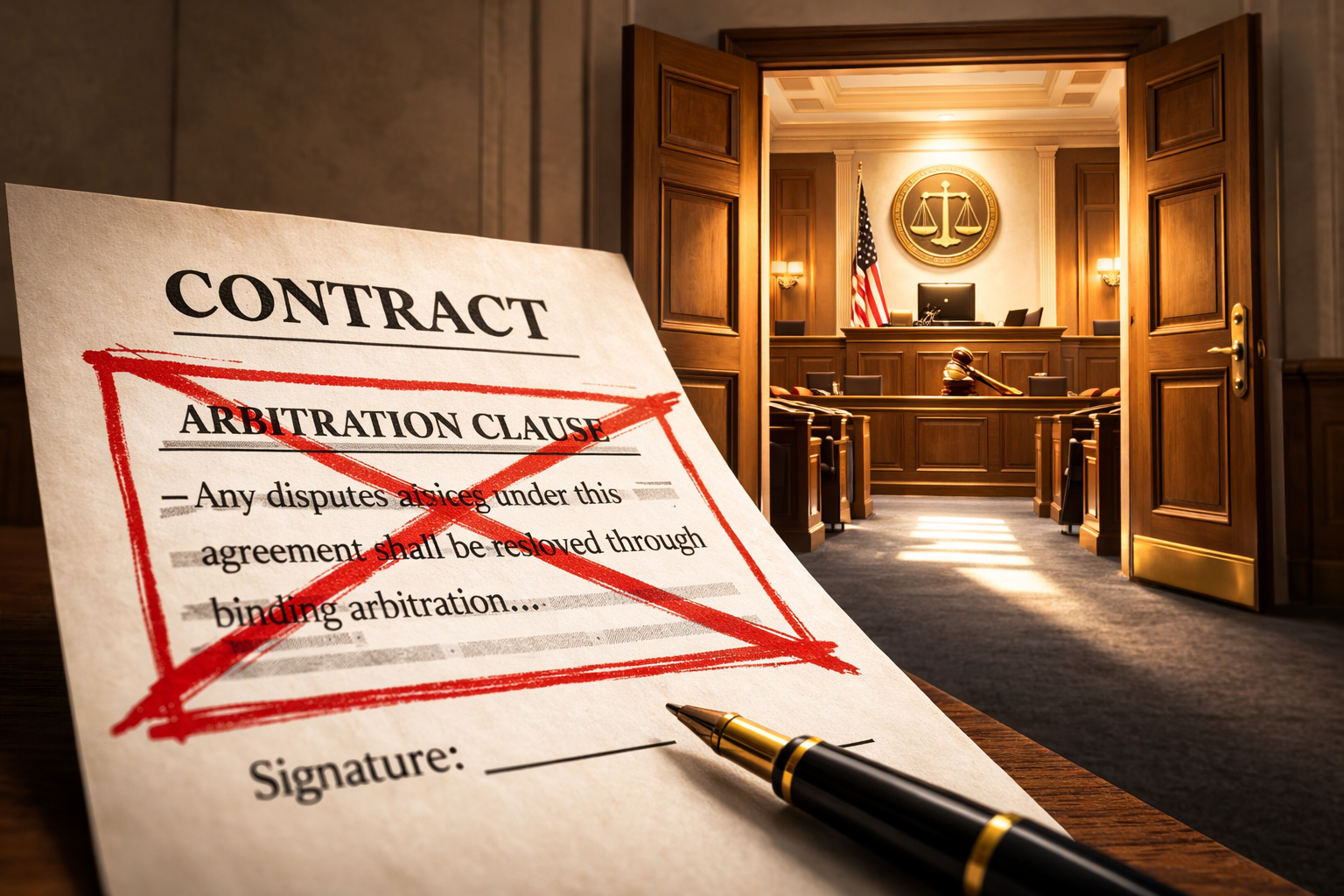
Opening the door to arbitration
In 1925, Congress enacted the Federal Arbitration Act (“FAA”) to ensure that agreements to arbitrate would be enforced according to their terms. At the time, some courts were reluctant to honor arbitration clauses. The statute was designed to reverse that hostility and place arbitration agreements on equal footing with other contracts.
The expansion of arbitration
For decades, arbitration largely occupied traditional territory—commercial disputes, maritime matters, securities cases, and labor agreements. In recent decades, however, arbitration expanded into employment, consumer, healthcare, franchise, and technology disputes. Critics characterized this expansion—particularly in employment and consumer contracts—as “forced arbitration,” arguing that statutory rights were being resolved in confidential, non-public forums.
Me too and the “secret” hearing room
Broad legislative efforts to curb arbitration gained little traction. Then the national focus shifted. In 2017, amid the #MeToo movement, attention turned to the possibility that sexual harassment and assault claims were being resolved privately, outside public scrutiny. Congress responded with the Ending Forced Arbitration of Sexual Assault and Sexual Harassment Act of 2021 (“EFAA”). Claimants may elect to go to court despite any pre-dispute arbitration clause in cases involving sexual assault or sexual harassment.
How many forums?
But that raised an important question. Many employment complaints include not only harassment allegations but also other statutory or common-law claims for discrimination, retaliation, wage violations, and the like. Does the EFAA permit only the harassment claim to proceed in court, leaving the rest in arbitration? Or does it keep the entire case in court? As a practical matter this is important to plaintiff/claimants. Requiring parallel proceedings would increase cost and complexity. And that could dilute the practical impact of the statute.
The Sixth Circuit recently addressed this issue in Randi Marie Bruce v. Adams and Reese, LLP, No. 25-5210 (6th Cir. 2026). The court concluded that, when a case includes a covered sexual harassment claim, the action as a whole may proceed in court. Focusing on the statute’s reference to a “case,” and viewing that term in its ordinary procedural sense, the court declined to require claim-splitting between court and arbitration.
Will other circuits follow?
Other circuits have yet to weigh in. The issue will turn on how courts balance two forces that have shaped arbitration law for decades: the strong judicial support for enforcing arbitration agreements under the FAA, and Congress’s clear purpose in the EFAA to bring allegations of sexual harassment and assault into the public forum. The Sixth Circuit viewed the statute through the lens of that purpose and concluded that fragmenting claims would undercut it.
Whether other courts will strike that balance the same way remains to be seen. The Sixth Circuits logic, focusing on the words and purpose of the statute seems sound.
But we now know for certain that, at least in one circuit, when a complaint includes sexual harassment within the meaning of the EFAA, the courthouse doors are open to all the claims in the case.